

Huroob in Saudi Arabia : How to Avoid Huroob Fines and Final Exit , Complete Guide in 2026
If you are working in Saudi Arabia as an expatriate worker, you must be aware of one of the most serious labor-related terms in the Kingdom — Huroob. A Huroob report can severely damage your legal status, result in heavy financial penalties, and even lead to a permanent travel ban. Whether you are an employee, an employer, or a sponsor (kafeel), understanding the Huroob system is absolutely essential.
This guide covers everything you need to know: what Huroob means, the consequences of a Huroob report, how to check Huroob status online, steps to remove or contest a Huroob report, how to avoid fines, and the proper procedure for the Final Exit from Saudi Arabia.
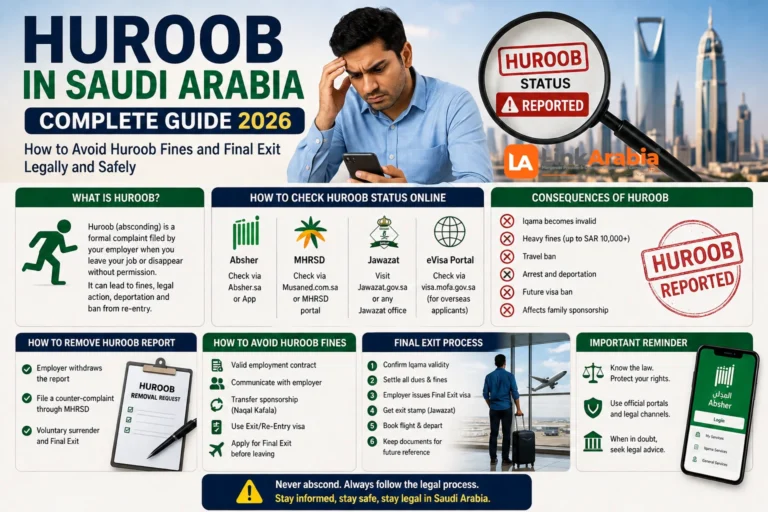
The word Huroob (ھروب اقامہ) is an Arabic term that literally translates to “fleeing” or “absconding” in English. In the context of Saudi Arabian labor law and the Kafala (sponsorship) system, Huroob refers to the formal accusation made by a sponsor or employer (kafeel) against a foreign worker when the worker:
- Leaves their place of work without the employer’s permission
- Disappears or fails to report to duty
- Runs away from their sponsor without legal authorization
- Overstays or abandons their contractual obligations
Once a Huroob report is filed through the Saudi Ministry of Human Resources and Social Development (MHRSD) or the General Directorate of Passports (Jawazat), the foreign worker is officially recorded as an absconder in the Saudi system. This immediately affects the worker’s Iqama (residency permit), travel permissions, and future visa eligibility.
Huroob Meaning in the Kafala System
Saudi Arabia operates under the Kafala sponsorship system, which legally ties a foreign worker to their employer. Under this system:
- Your employer is your legal sponsor
- You cannot change jobs or leave Saudi Arabia without employer consent
- If you leave your job without authorization, your sponsor can file a Huroob complaint
This is why the term is so significant — it is not merely an administrative note but a formal legal complaint with serious civil and criminal consequences.
Who Can File a Huroob Report?
Under Saudi labor regulations, only the registered employer or kafeel (sponsor) can file a Huroob report against a worker. The report can be filed through:
- The Ministry of Human Resources and Social Development (MHRSD) portal
- The Musaned platform (for domestic workers)
- The Jawazat (Passport Authority) offices
- The Absher platform (the unified e-government platform)
Employers are required to file a Huroob report within a certain period of the worker’s absence. Failing to file — or filing fraudulently — also carries its own set of consequences for the employer.
Consequences of a Huroob Report
When a Huroob report is filed against you, the following consequences take effect almost immediately:
1. Iqama Becomes Invalid
Your Iqama (residence permit) is suspended or flagged in the system, meaning you are effectively living and working illegally in Saudi Arabia.
2. Saudi Arabia Travel Ban
You will be placed on a travel watchlist, and you may not be allowed to exit Saudi Arabia through normal channels without resolving the Huroob case first.
3. Arrest and Deportation
Saudi authorities actively monitor those under a Huroob status. If caught, you may be arrested, detained, and deported — often with a long-term or permanent ban on re-entry into Saudi Arabia.
4. Huroob Fines and Penalties
The financial penalties for Huroob in Saudi Arabia are substantial. Huroob fines can reach SAR 10,000 or more depending on the duration of the absconding and the nature of the case. Additional fines for overstaying and illegal residency may also be added.
5. Future Visa Ban
Workers who have a Huroob record are typically banned from re-entering Saudi Arabia or any GCC country for years, and in some cases permanently.
6. Huroob on Family Members (impact)
If your family members are on your dependent Iqama (under your sponsorship), their legal status may also be affected when a Huroob is filed against you.
How to Check Huroob Status — Complete Step-by-Step Guide
One of the most important actions any expatriate in Saudi Arabia should take is to regularly check their Huroob status to ensure they are in good legal standing. Saudi Arabia provides several online portals to check Huroob status quickly and easily.
How to Check Huroob Online via the Absher Platform
Absher (أبشر) is Saudi Arabia’s official e-government portal and is the most widely used method for checking Huroob status online.
Step-by-Step Instructions:
- Visit the Absher website at absher.sa or open the Absher mobile app (available on Android and iOS).
- Log in using your Iqama number and registered mobile number.
- Enter the OTP (One-Time Password) sent to your phone for verification.
- Once logged in, navigate to the “My Services” or “Individuals” section.
- Click on “Residency Services” or “Iqama Services.”
- Select “Residency Status” or look for an option labelled “Absconding Inquiry” or “Huroob Inquiry.”
- The system will display your current status — whether your Iqama is active, flagged, or has a Huroob complaint filed against it.
💡 Tip: If you see a red flag or a notation that says “Huroob,” this means a report has been formally filed and you must take immediate action. |
How to Check Huroob Status via the MHRSD Portal
The Ministry of Human Resources and Social Development (MHRSD) also allows workers to check their labor status, including Huroob complaints.
- Visit musaned.com.sa or the MHRSD portal at mhrsd.gov.sa.
- Choose the “Workers” or “Musaned” section from the menu.
- Log in using your credentials or Iqama number.
- Navigate to “Contract and Employment Status.”
- Check if there is any pending absconding complaint or Huroob case against your Iqama.
How to Check Huroob via Jawazat (Passport Authority)
- Visit any Jawazat office in Saudi Arabia in person.
- Alternatively, visit jawazat.gov.sa for online services.
- Enter your Iqama number and personal information.
- Check for any travel bans, Huroob records, or legal violations on your residency file.
How to Check Huroob Status via the Visa Inquiry Tool (For Overseas Expats)
If you have already left Saudi Arabia and want to check whether a Huroob report has been filed against you before re-applying for a visa:
- Visit the Saudi eVisa portal at visa.mofa.gov.sa.
- Enter your passport number and personal details.
- The system will indicate whether you have any travel bans or Huroob records that would prevent visa issuance.
How to Check Huroob Status — Step by Step Guide Summary Table
Method | Platform | Who Can Use |
Absher App/Website | absher.sa | Expats in Saudi Arabia |
MHRSD / Musaned Portal | musaned.com.sa | Workers & Domestic Staff |
Jawazat Office / Website | jawazat.gov.sa | All Residents |
Saudi eVisa Portal | visa.mofa.gov.sa | Overseas Applicants |
Saudi Embassy Abroad | Local Embassy | Those Outside Saudi Arabia |
How to Remove a Huroob Report
If a Huroob report has been filed against you — whether legitimately or falsely — here is what you need to do:
Option 1: Employer Withdraws the Huroob Report
The easiest and fastest solution is for your employer (kafeel) to cancel the Huroob complaint:
- Log into their Absher or MHRSD employer account.
- Navigate to the Huroob complaint filed.
- Select “Cancel” or “Withdraw” the Huroob report.
- Submit the cancellation request officially.
Once withdrawn, the Huroob status is removed from your record — though this does not automatically erase accumulated fines.
Option 2: File a Counter-Complaint Through MHRSD
If the Huroob report is false or retaliatory, you have the right to file a counter-complaint through the MHRSD Labour Dispute Committees or the Saudi Labour Courts. You will need evidence such as:
- Proof that you were attending work
- Salary payment records
- Communication with the employer
- Witness statements or contract copies
Option 3: Voluntary Surrender and Final Exit
Some workers choose to surrender to the Jawazat or police voluntarily and request to leave via the Final Exit option, especially if they no longer wish to work in Saudi Arabia.
How to Avoid Huroob Fines in Saudi Arabia
Prevention is always better than cure. Here is how to legally protect yourself from a Huroob report:
1. Always Have a Valid Contract
Ensure your employment contract is registered with MHRSD. This creates a legally binding record and gives you protection if disputes arise.
2. Communicate With Your Employer
If you have workplace issues — salary delays, contract violations, or abuse — do not simply abandon your workplace. Instead, file a formal complaint with the MHRSD or the Labour Court.
3. Request a Transfer of Sponsorship (Naqal Kafala)
Saudi Arabia now allows workers to transfer their sponsorship without employer consent in many cases, under the 2021 labor reforms. This is a legal and safe alternative to absconding.
4. Use the Exit/Re-Entry Visa Properly
If you need to leave Saudi Arabia temporarily, always obtain an Exit/Re-Entry visa from your employer. Leaving without this visa may trigger a Huroob complaint.
5. Apply for Final Exit Before Leaving
If you plan to leave Saudi Arabia permanently, apply for a Final Exit Visa through Absher or through your employer. This closes your Iqama legally and prevents any future Huroob filing.
6. Know Your Rights Under Saudi Labor Law
Saudi Arabia has made significant labor law reforms in recent years. Workers now have stronger protections, including the right to:
- Change employers in certain conditions
- File complaints about wage theft or abuse
- Access free legal aid through MHRSD
Huroob Fines — How Much Do They Cost?
The Saudi government imposes escalating fines based on how long a worker has been under Huroob status:
Duration of Huroob | Approximate Fine (SAR) |
Less than 3 months | SAR 2,000 – 5,000 |
3 to 6 months | SAR 5,000 – 10,000 |
More than 6 months | SAR 10,000 + additional penalties |
Illegal residency overstay | SAR 200/day (up to SAR 20,000) |
Note: These are approximate figures and may vary based on case specifics and current Saudi regulations. Always verify with official MHRSD sources.
Conclusion
Huroob in Saudi Arabia is a serious legal matter that every expatriate worker and employer must understand thoroughly. A Huroob report can destroy years of hard work, result in deportation, and block future opportunities in Saudi Arabia and the wider GCC region.
The good news is that Saudi Arabia now offers multiple online tools — including Absher, MHRSD, and Musaned — to check Huroob status quickly and conveniently. With the 2021 labor reforms, workers also have more legal options than ever before to resolve disputes legally rather than resorting to absconding.
If you are facing workplace issues, always seek legal advice through MHRSD, file a formal complaint, and explore sponsorship transfer or Final Exit as legitimate pathways. Never abandon your workplace without taking proper legal steps — the consequences of Huroob far outweigh any temporary relief it may seem to offer.
Stay informed, know your rights, and always use the official channels to protect yourself in the Kingdom of Saudi Arabia.
⚠️ Disclaimer: This article is for informational purposes only. Saudi labor laws are subject to change. Always consult official Saudi government sources or a qualified legal professional for advice specific to your situation. |