
10 Costly Resume CV Mistakes Killing Your Overseas Job Dream in Pakistan
Every year, hundreds of thousands of Pakistanis look for better opportunities abroad. The dream is real — better salaries, foreign exposure, and the ability to support families back home.
But here is something that many job seekers overlook.
A weak or poorly prepared resume and CV is one of the top reasons Pakistani workers get rejected even before reaching the interview stage.
Understanding the most common resume CV mistakes overseas jobs Pakistan applicants make is the first step toward a stronger, more competitive application. This guide breaks down 10 critical mistakes, explains why they hurt your chances, and shows you exactly how to fix them.
Whether you are targeting the Gulf region, Europe, Malaysia, or any other country, these insights apply across the board.
Your CV is your first impression. International recruiters and employers receive hundreds — sometimes thousands — of applications for a single position.
In many cases, your resume gets only 6 to 10 seconds of attention before a decision is made to move forward or reject.
That means formatting, language, structure, and accuracy all matter enormously. A single avoidable mistake can send your application straight to the rejection pile.
This is especially true for overseas jobs, where cultural expectations, documentation requirements, and professional standards may differ from what you are used to in Pakistan.
If you want to learn more about how the overseas job process works, you can read our detailed guide at linkarabiapk.com/blog.
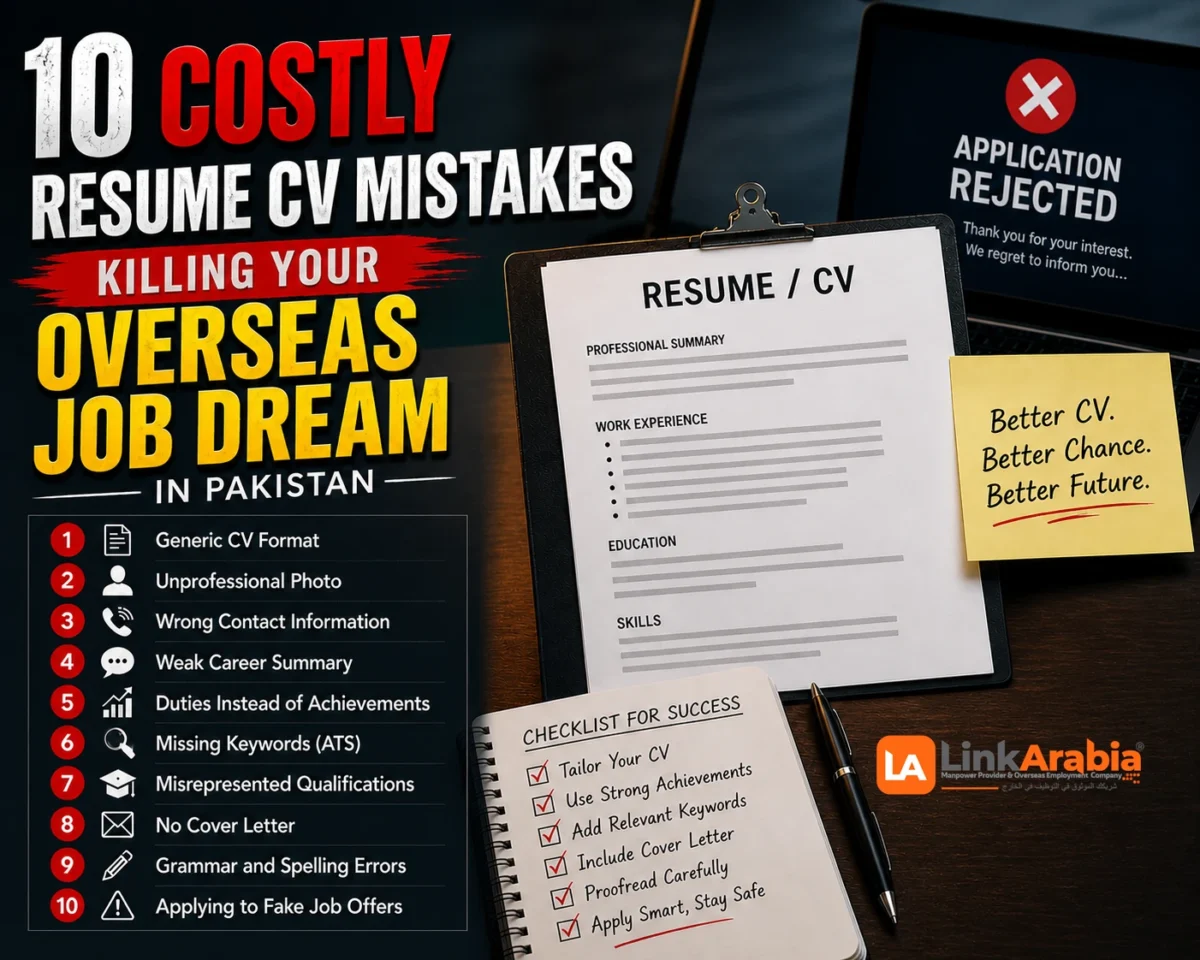
Mistake #1: Using a Generic or Outdated CV Format
One of the most widespread resume CV mistakes Pakistani job seekers make is submitting a generic, one-size-fits-all CV.
Many applicants use the same CV for every job they apply to, regardless of the industry, country, or role. This approach signals to recruiters that you have not taken the time to tailor your application.
International employers, especially in the Gulf, Europe, and Southeast Asia, have different expectations compared to local Pakistani employers.
How to fix it:
- Research the standard CV format preferred in the target country.
- Tailor your CV to match the specific job description.
- Use a clean, modern layout with clearly defined sections.
- Avoid heavy graphics, unusual fonts, or cluttered designs unless you are applying for a creative role.
For Gulf jobs specifically, a one to two page CV with a clear structure is generally preferred. For European applications, the Europass CV format is widely recognised.
Mistake #2: Including an Unprofessional or Incorrect Photo
In Pakistan, it is common to attach a photograph to a CV. However, when applying for overseas jobs, the rules are different depending on the country.
For jobs in the UK, USA, Canada, or Australia, including a photo can actually work against you, as employers in these countries avoid photos to prevent unconscious bias in hiring.
For Gulf countries, a professional passport-size photo is usually acceptable and sometimes expected.
How to fix it:
- Research the norms of the country you are applying to before adding a photo.
- If a photo is required, use a professional, recent passport-size image with a plain background.
- Avoid using casual selfies, cropped group photos, or old pictures.
Mistake #3: Missing or Incorrect Contact Information
This sounds like a basic error, but it is surprisingly common among Pakistani overseas job applicants.
Many CVs are submitted with outdated phone numbers, inactive email addresses, or missing WhatsApp details — all of which are critical for international recruiters to reach you quickly.
International time zone differences mean recruiters often rely on email and messaging apps for initial contact. If your contact details are wrong, your application simply dies.
How to fix it:
- Double-check all phone numbers and add your country code (e.g., +92 for Pakistan).
- Use a professional email address — avoid addresses like coolguy123 or princeofpakistan.
- Include your WhatsApp number if you are applying to Gulf or Asian employers.
- Add your LinkedIn profile URL if it is updated and professional.
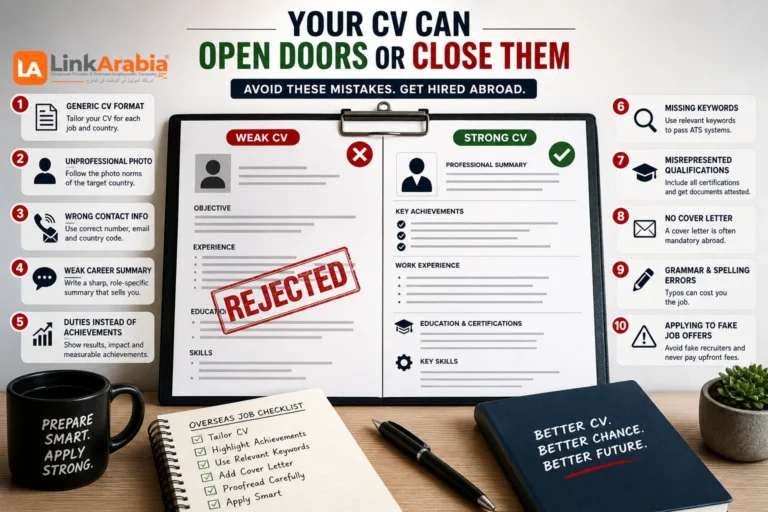
Mistake #4: A Weak or Missing Career Summary
Pakistani job seekers frequently skip the career summary section or write something vague and generic like “seeking a challenging position in a reputable organisation.”
International recruiters read hundreds of these meaningless statements every day.
A strong career summary gives the employer an immediate snapshot of who you are, what you have done, and what value you bring. It is your 3-sentence pitch.
How to fix it:
- Write a focused, 3 to 4 sentence summary that mentions your years of experience, key skills, and top achievement.
- Match your summary to the specific role you are applying for.
- Use strong action words and quantifiable outcomes where possible.
Example: “Experienced Civil Engineer with 7 years of on-site project management across Pakistan and UAE. Specialised in large-scale infrastructure projects with a proven record of delivering on time and within budget. Looking to contribute expertise to high-value construction projects in the Gulf region.”
Mistake #5: Listing Job Duties Instead of Achievements
This is one of the most damaging resume CV mistakes overseas jobs Pakistan candidates make repeatedly.
Most applicants write their work experience as a list of responsibilities — things they were supposed to do. International employers are far more interested in what you actually achieved in those roles.
Listing duties tells recruiters what your job description said. Listing achievements tells them what you actually delivered.
How to fix it:
- Replace duty-based bullet points with achievement-based statements.
- Use the format: Action Verb + Task + Measurable Outcome.
- Example (wrong): “Responsible for managing a team.”
- Example (right): “Led a team of 12 technicians, reducing project turnaround time by 30% over 6 months.”
For more tips on writing achievement-focused content, visit the career writing resources at linkarabiapk.com/blog.
Mistake #6: Ignoring Keywords from the Job Description
Recruiters in many countries — especially those using Applicant Tracking Systems (ATS) — screen CVs automatically using software before a human ever reads them.
If your CV does not contain relevant keywords from the job posting, it may be filtered out before reaching any recruiter.
This is a mistake that costs Pakistani overseas job applicants enormously, especially when applying through online job portals.
How to fix it:
- Read the job description carefully and identify repeated keywords related to skills, tools, qualifications, and job titles.
- Naturally incorporate these keywords throughout your CV — in your summary, skills section, and work experience.
- Avoid keyword stuffing; maintain natural, readable language.
You can refer to resources like LinkedIn’s Career Advice for guidance on writing ATS-friendly resumes.
Mistake #7: Omitting or Misrepresenting Certifications and Qualifications
When applying for overseas jobs from Pakistan, certifications and educational qualifications carry significant weight — but only if they are correctly listed and properly attested.
A common mistake is either leaving out key certifications or misrepresenting qualifications. Both can damage your application severely. In many countries, misrepresentation of qualifications is a legal issue that can lead to immediate termination or visa cancellation.
How to fix it:
- List all relevant certifications accurately — including the issuing body and year.
- For overseas applications, ensure your educational documents are attested from the relevant Pakistani authorities.
- HEC (Higher Education Commission) attestation is required for degree holders.
- Attestation from the Ministry of Foreign Affairs and then the target country’s embassy is often required.
Mistake #8: Sending a CV Without a Cover Letter
Many Pakistani job seekers believe a CV alone is enough. In the international job market, this is rarely true.
A cover letter is your opportunity to speak directly to the employer, explain why you are the right fit, and demonstrate that you have researched the company and role.
Skipping the cover letter — especially for jobs in Europe, North America, and some Gulf organisations — signals a lack of effort and professionalism.
How to fix it:
- Always write a tailored cover letter unless the job posting specifically says not to.
- Keep it to three short paragraphs: why you are interested, what you bring, and what you want from the role.
- Address it to a named person if possible, rather than “To Whom It May Concern.”
- Match the tone and language style to the target country’s professional culture.
Mistake #9: Typos, Grammar Errors, and Informal Language
Spelling mistakes, grammatical errors, and informal language in a CV are among the most immediate reasons for rejection in overseas applications.
For Pakistani job seekers applying to English-speaking or formal work environments, grammar errors send a signal that you may lack attention to detail or professional communication skills.
This is especially critical in roles involving client interaction, report writing, or supervisory responsibilities.
How to fix it:
- Proofread your CV at least three times before sending.
- Use tools like Grammarly or Microsoft Editor to catch errors automatically.
- Ask a trusted friend, colleague, or professional to review the document.
- Avoid informal phrases, abbreviations, or overly casual language.
- Write in clear, formal, and concise English.
Mistake #10: Applying to Unverified Job Postings and Fake Recruiters
This is perhaps the most serious mistake — and unfortunately, one of the most common.
Thousands of Pakistani workers have been deceived by fake job offers from unverified sources. Fraudulent recruiters promise high salaries, visas, and good work conditions, and then charge hefty upfront fees, disappear, or send workers to completely different conditions than promised.
No legitimate overseas employer asks you to pay recruitment fees upfront. This is a clear warning sign of a scam.
How to fix it:
- Only apply through licensed and registered overseas employment promoters. Licensed recruitment agencies in Pakistan
- Verify that any recruiter or agency you deal with is registered with the relevant Pakistani authorities.
- Do not pay any upfront fee for a job offer or visa arrangement without proper verification.
- Check for verified job postings through official government platforms and reputable job portals.
You can explore guidance on verifying overseas job offers on our blog at linkarabiapk.com/blog.
The MOPHRD (Ministry of Overseas Pakistanis and Human Resources Development) actively works to protect Pakistani workers abroad and provides resources for overseas employment verification. Visit their official portal for updated guidance.
Bonus Mistake: Not Researching the Target Country's Work Culture
Beyond your resume and CV, many Pakistani applicants fail to research the professional culture of the country they are applying to.
For example, CV length norms differ. In the UK, a two-page CV is standard. In Germany, a detailed structured CV with a photo is expected. For Middle Eastern countries, including educational background and religion is sometimes part of the standard format.
How to fix it:
- Research the country-specific CV and application norms before applying.
- Look at examples of CVs that are accepted in that country or region.
- Understand the professional communication style expected in that culture.
Our resource section at linkarabiapk.com/blog covers CV formats for different target countries that Pakistanis commonly apply to.
Final Checklist Before Submitting Your Overseas Job CV
Before sending out your next overseas job application, run through this checklist:
✅ CV is tailored to the specific job and country
✅ Contact information is accurate and includes country code
✅ A strong career summary is included
✅ Work experience is listed with achievements, not just duties
✅ Keywords from the job description are naturally included
✅ All qualifications and certifications are accurately listed
✅ A professional cover letter is attached
✅ The document has been proofread for grammar and spelling
✅ The job posting and recruiter have been verified
✅ The file is saved as a PDF with a professional filename
Take the time to review each point carefully. A well-prepared application package significantly improves your chances of getting shortlisted.
Conclusion
The overseas job market is highly competitive. Thousands of Pakistani professionals and skilled workers are applying for the same positions every day.
What separates those who get shortlisted from those who get rejected often comes down to the quality and professionalism of their resume and CV.
By understanding and correcting the most common resume CV mistakes overseas jobs Pakistan applicants make — from poor formatting and missing achievements to weak cover letters and falling for fake job offers — you put yourself in a much stronger position.
Take the time to build a CV that truly represents your skills, experience, and professionalism. Research the expectations of your target country. Verify every job opportunity you pursue.
Your overseas career journey deserves to start on the right foot.
For more helpful guides, tips, and resources on overseas jobs from Pakistan, visit linkarabiapk.com/blog.
⚠️ DISCLAIMER

The information provided in this article is intended for general informational purposes only. It does not constitute professional legal, financial, or career advice. While every effort has been made to ensure the accuracy of the information presented, the employment landscape, government regulations, and overseas labour market conditions are subject to change.

Readers are strongly encouraged to conduct their own independent research, consult with qualified professionals, and verify the credentials and licensing of any recruitment agency before engaging their services.

Always check with relevant government authorities, including the Ministry of Overseas Pakistanis and Human Resources Development (MOPHRD), for the most current regulations and approved agency listings.

linkarabiapk.com does not endorse, represent, or take responsibility for any specific recruitment agency or third-party service mentioned or implied in this content.