
7 Powerful Benefits of Using Recruitment Agencies in Pakistan in 2026
Pakistan’s job market has never been more competitive. Whether you are a fresh graduate stepping into the workforce or a seasoned professional exploring overseas career options, navigating the employment landscape alone can feel overwhelming.
This is where recruitment agencies in Pakistan step in.
These agencies have long served as a bridge between talent and opportunity. In 2026, their role has grown even more significant — shaped by digital transformation, rising overseas demand, and a rapidly evolving domestic economy.
Let’s explore why recruitment agencies in Pakistan remain a powerful force in the world of employment — and how they continue to add real value for both job seekers and employers.
Pakistan’s labour market is at a pivotal point.
According to the Pakistan Bureau of Statistics, the country’s labour force has grown substantially over the past decade. With a young population and a growing middle class, demand for structured, professional employment channels is on the rise.
At the same time, the International Labour Organization (ILO) highlights that developing economies like Pakistan still face challenges around skills mismatches, informal employment, and limited access to global job markets.
Recruitment agencies serve as a practical solution to many of these challenges.
They offer structured pathways to employment — both domestically and abroad — and help workers navigate visa requirements, documentation, and employer negotiations.
The labour market in 2026 also reflects a significant post-pandemic shift. Remote work, digital skills, and vocational training have all gained new importance. Agencies that have adapted to these trends are now in a stronger position than ever.
What Do Recruitment Agencies in Pakistan Actually Do?
Many people assume recruitment agencies are simply middlemen who pass CVs from one desk to another. The reality is far more layered — and far more valuable.
Recruitment agencies in Pakistan today function as full-cycle workforce solution providers. Their work begins long before a candidate submits an application, and it continues long after a worker lands their first day on the job.
To understand the true scope of what professional agencies offer, it helps to look at the complete range of services that have become standard in the industry. You can explore a detailed overview of what modern agencies bring to the table at this comprehensive service breakdown for Pakistan’s recruitment sector.
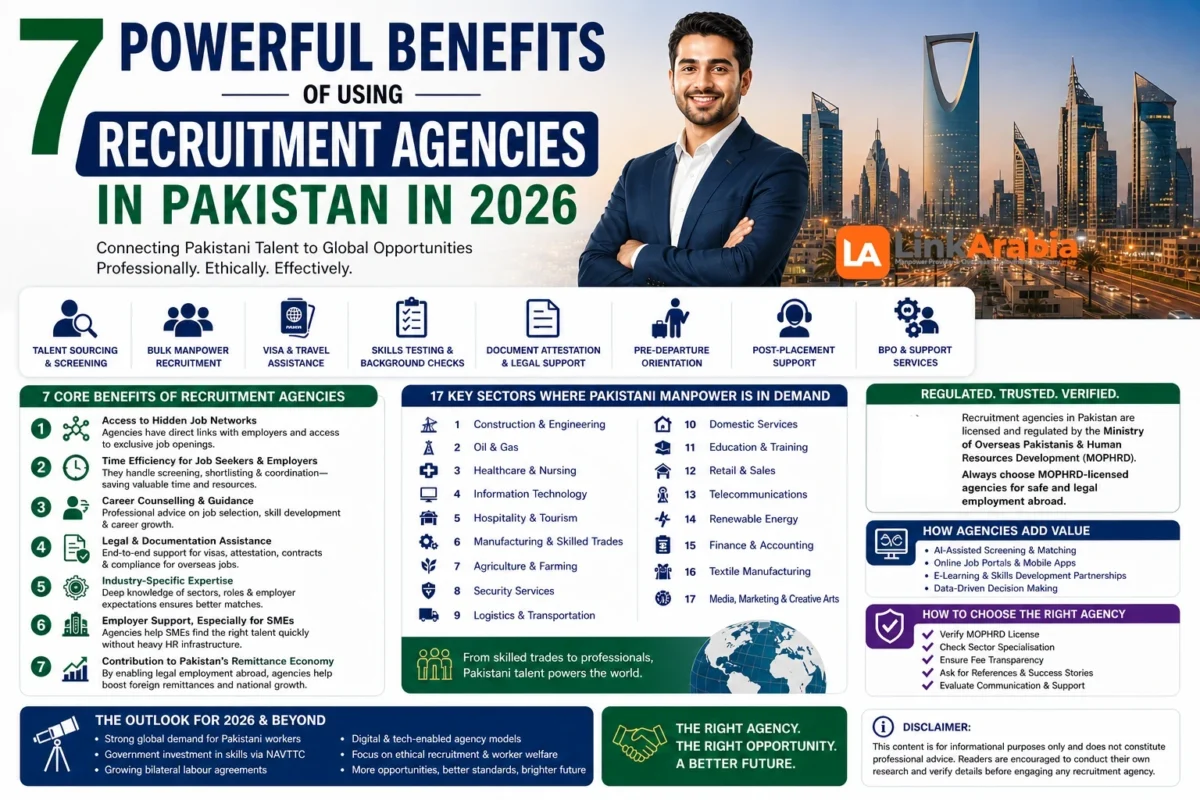
Here is a closer look at the core service areas that define how recruitment agencies in Pakistan operate in 2026:
Talent Sourcing
Talent sourcing is the foundation of everything a recruitment agency does.
It goes well beyond posting a job ad and waiting. Agencies actively search for candidates through structured databases, trade networks, social platforms, referral pipelines, and community outreach — especially in smaller cities and rural areas where skilled workers often go unnoticed.
The goal is to identify the right person before the employer even has to ask.
This proactive approach is particularly valuable for overseas employers who have no physical presence in Pakistan and rely entirely on the agency’s sourcing capability to find suitable candidates.
Bulk Manpower Recruitment
When large-scale projects come to life — construction megaprojects in the Gulf, manufacturing expansions across Asia, or infrastructure developments in emerging markets — employers need hundreds of workers within defined timeframes.
This is where bulk manpower recruitment becomes critical.
Agencies handling large-volume assignments coordinate mass recruitment drives, organise trade tests, conduct group interviews, and manage the logistics of moving large numbers of workers through the documentation and clearance pipeline simultaneously.
This capacity requires systems, experience, and coordination that no individual job seeker can replicate on their own.
Employment Visa Services
Visa processing is one of the most complex and high-stakes parts of the overseas employment journey.
Requirements vary significantly between destination countries. Saudi Arabia, the UAE, Qatar, Oman, and other major destinations each have their own procedures, approved medical testing centres, visa categories, and contract verification requirements.
Experienced recruitment agencies in Pakistan manage this entire process — from demand letter verification and contract authentication to medical coordination and visa stamping.
This service alone saves workers from costly mistakes, delays, and in some cases, outright fraud.
Skills Testing Solutions
Employers hiring from overseas cannot always interview workers in person.
Skills testing addresses this gap directly. Reputable agencies conduct structured assessments — whether trade tests for electricians, welders, and plumbers, language proficiency evaluations, or technical assessments for IT and engineering roles — before presenting candidates to overseas clients.
This gives employers confidence in the quality of the candidates being proposed, and it gives workers the opportunity to formally demonstrate their competencies.
In 2026, skills testing has become increasingly digital like Takamol Skills Testing Facility introduced by Saudi Arabia , with agencies using standardised tools to assess and certify candidates in a verifiable, internationally recognised format.
Background Checks and Document Verification
Credibility is non-negotiable in international recruitment.
Agencies carry out thorough background checks to confirm a candidate’s identity, criminal record status, employment history, and academic qualifications. Document attestation — verifying that certificates and credentials meet the legal requirements of the destination country — is also a key part of this process.
This protects employers from hiring individuals with misrepresented qualifications and protects workers from entering contracts with fraudulent intermediaries.
Job Matching and Candidate Placement
At its core, job matching remains the essential function of every agency.
However, in 2026, job matching is far more sophisticated than it once was. Agencies use candidate profiling, skill-gap analysis, and employment history mapping to align the right candidate with the right role.
The best agencies do not simply fill positions — they aim for sustainable placements where both the worker and the employer benefit over the long term. Successful placements reduce turnover, build repeat business with employers, and strengthen the agency’s reputation.
Documentation Support and CV Development
Not every job seeker arrives at an agency with a polished CV or a clear understanding of what employers expect.
Agencies provide hands-on support — helping candidates structure their CVs, write appropriate cover letters, and prepare the supporting documentation required for applications both locally and overseas.
This service is particularly meaningful for blue-collar and semi-skilled workers who may have strong practical capabilities but limited experience navigating formal application processes.
Pre-Departure Orientation
Licensed recruitment agencies in Pakistan — those operating under the framework of the Ministry of Overseas Pakistanis and Human Resources Development (MOPHRD) — are required to conduct pre-departure briefings for outgoing overseas workers.
These sessions cover a wide range of critical topics:
- Understanding the employment contract and workers’ rights
- Cultural norms and workplace expectations in the destination country
- Emergency contacts and legal support channels abroad
- Financial planning and remittance guidance
- Health and safety information for the specific role
Pre-departure orientation is not a formality. It is a practical preparation tool that reduces the risk of exploitation, cultural misunderstanding, and contract disputes once the worker is abroad.
Business Process Outsourcing (BPO) and HR Services
Beyond individual placements, a number of established agencies in Pakistan have expanded into business process outsourcing — taking on HR management, payroll administration, and workforce compliance functions on behalf of client companies.
This is especially useful for overseas employers or multinational businesses that need a trusted local partner to manage Pakistan-based operations or remote teams without establishing a full in-country HR department themselves.
Post-Placement Follow-Up and Worker Support
The responsibility of a professional recruitment agency does not end the moment a worker boards a flight.
Reputable agencies maintain contact with placed workers and their employers after deployment. If an issue arises — a contract dispute, a welfare concern, or an unexpected change in work conditions — the agency acts as a point of contact and mediation.
This ongoing support is one of the clearest signs that distinguishes a professional agency from an opportunistic one. Workers should always ask any agency they engage with about their post-placement support policy before committing.
Taken together, this range of services makes recruitment agencies in Pakistan far more than a notice board or a directory of job listings.
They are end-to-end workforce partners — serving job seekers, supporting employers, and playing a meaningful role in Pakistan’s broader labour export ecosystem.
For a deeper look into how the overseas placement process works from start to finish, visit our detailed guide on how overseas recruitment works for Pakistani workers.
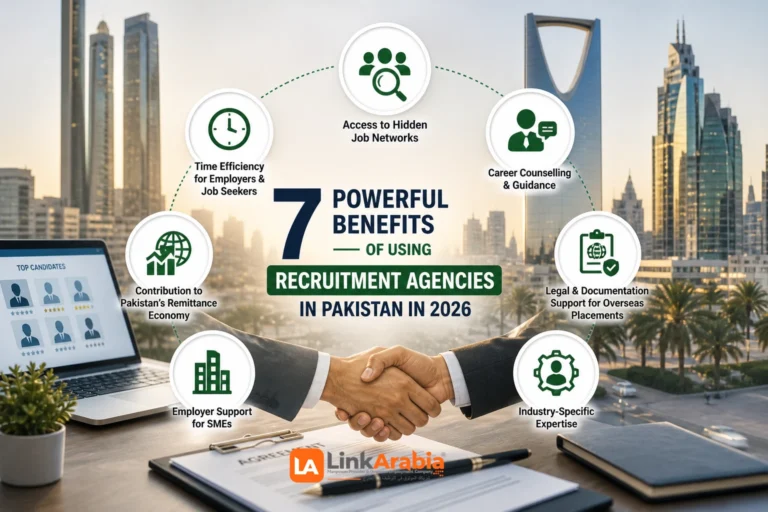
7 Powerful Benefits of Using Recruitment Agencies in Pakistan
- Access to a Wider Network of Job Opportunities
Most job vacancies — especially high-value overseas positions — are never publicly advertised.
Employers prefer to work through trusted recruitment agencies to save time and maintain confidentiality. This means that many of the best opportunities are only accessible through an agency network.
Recruitment agencies in Pakistan have established relationships with employers in the Gulf, Europe, Asia, and beyond. Registering with a reputable agency opens doors that would otherwise remain closed to individual job seekers.
- Time and Effort Efficiency
Job searching is exhausting.
From writing applications to attending interviews and following up on responses, the process demands considerable time and energy. Agencies streamline this process significantly.
They pre-screen candidates, match profiles to relevant roles, and schedule interviews — saving both the job seeker and the employer considerable time.
For employers, this is particularly valuable. Hiring managers can focus on their core responsibilities while the agency handles the sourcing and initial vetting.
- Professional Guidance and Career Counselling
Not every job seeker knows what role suits them best, or how to present their skills effectively.
Many recruitment agencies in Pakistan offer career counselling as part of their services. They help candidates understand their market value, improve their CV, and prepare for interviews.
This guidance can make a significant difference — especially for workers entering the job market for the first time or transitioning to a new industry.
- Legal and Documentation Assistance for Overseas Jobs
One of the most critical aspects of overseas employment is the legal framework.
Work visas, medical tests, attestation of documents, and contracts can be confusing — particularly for first-time overseas workers.
Licensed recruitment agencies in Pakistan — those registered with the Ministry of Overseas Pakistanis and Human Resources Development (MOPHRD) — are equipped to handle this documentation. They guide workers through each step, helping to avoid delays, fraud, and exploitation.
This is especially important given that the World Bank’s migration data consistently shows that workers who migrate through formal channels tend to have better outcomes than those who go through informal routes.
Explore more about documentation requirements for overseas jobs in our blog post on how to prepare documents for Gulf employment.
5. Industry-Specific Expertise
Different industries require very different hiring approaches.
A construction company recruiting forklift operators has entirely different needs from a hospital hiring nurses or an IT firm looking for software developers.
Recruitment agencies in Pakistan that specialize in specific sectors bring deep industry knowledge. They understand technical requirements, salary benchmarks, and employer expectations in ways that general job boards simply cannot replicate.
This specialization leads to better matches — and fewer failed placements.
6. Support for Employers in Finding Skilled Talent
The benefit of recruitment agencies is not one-sided.
Employers — particularly small and medium enterprises (SMEs) — often lack the HR capacity to conduct large-scale recruitment drives. For them, outsourcing recruitment to a professional agency is not only practical but cost-effective.
Agencies handle the advertising, shortlisting, testing, and initial interviews. Employers receive a curated list of qualified candidates rather than hundreds of unfiltered applications.
This model works especially well in Pakistan’s growing manufacturing, construction, hospitality, and healthcare sectors.
7. Contribution to Pakistan's Remittance Economy
Pakistan’s remittance inflows are among the highest in South Asia.
Workers abroad send billions of dollars back to their families every year — funds that directly improve living standards and support the national economy.
Overseas recruitment agencies in Pakistan play a central role in facilitating this. By connecting workers with legitimate overseas employers, they contribute directly to the country’s economic stability.
According to the State Bank of Pakistan, remittances have remained one of the most stable sources of foreign exchange for the country. Recruitment agencies are a key enabler of this flow.
Key Industries Where Recruitment Agencies Are Making an Impact in 2026
The demand for recruitment agencies in Pakistan is not uniform across all industries.
Some sectors have been driving overseas placements for decades. Others are emerging rapidly in 2026, shaped by global economic shifts, regional development agendas, and Pakistan’s evolving workforce capabilities.
Below is a sector-by-sector breakdown of where Pakistani manpower is in demand — and where recruitment agencies are doing their most active work.
Construction and Engineering
Construction remains the single largest channel for Pakistani overseas manpower.
Gulf countries continue to invest in massive infrastructure projects. Saudi Arabia’s Vision 2030 programme alone encompasses hundreds of billions of dollars in construction activity — from NEOM to Red Sea tourism resorts to urban transport networks. The UAE, Qatar, Kuwait, and Oman are similarly engaged in large-scale development.
Pakistani workers have a long-established reputation in this sector. Civil engineers, site supervisors, structural steel workers, scaffolders, electricians, plumbers, pipefitters, masons, and general labourers are all in consistent demand.
What makes Pakistan particularly competitive here is the combination of technical skill, cost-effectiveness, and a workforce that is already culturally familiar with working conditions in the Gulf.
Recruitment agencies specialising in construction are seeing strong and sustained placement volumes — and this trend shows no sign of slowing through 2026 and beyond.
Oil, Gas, and Petrochemicals
Pakistan has been supplying skilled manpower to the oil and gas sector for well over four decades.
Refineries, petrochemical plants, offshore platforms, and LNG facilities across the Gulf, Malaysia, and parts of Africa consistently recruit Pakistani professionals for both technical and operational roles.
In demand are petroleum engineers, process engineers, instrument technicians, industrial pipefitters, safety officers (HSE), chemical plant operators, and maintenance crews.
As Gulf nations continue to diversify their energy mix and expand refining capacity, the need for experienced oil and gas manpower from Pakistan remains strong. Agencies with established relationships in this sector are among the most active in the country.
Healthcare and Nursing
The global nursing shortage has created significant and growing demand for Pakistani healthcare professionals.
Countries in Europe — particularly the UK, Germany, and the Nordic nations — along with the Gulf states and parts of East Asia, are actively recruiting trained nurses, paramedics, general physicians, surgical technicians, radiology staff, and healthcare support workers.
Pakistan produces a substantial number of healthcare graduates each year. However, the challenge has historically been around international certification and language proficiency.
Recruitment agencies that have invested in pre-clearance support — helping candidates obtain international nursing licenses, IELTS or OET certification, and credential verification — are now facilitating placements in growing numbers.
This is one of the sectors where the role of the agency is most critical. The documentation pathway for international healthcare placement is complex, and professional guidance significantly improves a candidate’s chances of a successful placement.
Information Technology
Pakistan has one of the fastest-growing tech talent pools in Asia.
The country produces tens of thousands of computer science and IT graduates annually. Cities like Lahore, Karachi, Islamabad, and increasingly Peshawar have active tech communities with strong software development, mobile application, and digital product capabilities.
Local and international companies are increasingly partnering with recruitment agencies to identify and place software developers, front-end and back-end engineers, UI/UX designers, data analysts, data scientists, machine learning engineers, cybersecurity professionals, cloud architects, and ERP consultants.
While remote work has allowed many Pakistani IT professionals to work for international clients without relocating, there remains strong demand for on-site placements in the Gulf, Europe, and Canada — particularly for senior and specialist roles.
Tech-focused recruitment agencies in Pakistan are seeing growing interest from employers in Saudi Arabia’s digital transformation initiatives, the UAE’s fintech sector, and European companies looking to fill talent gaps with cost-competitive skilled professionals.
Hospitality and Tourism
The hospitality sector has emerged as one of the most active areas for Pakistani manpower recruitment in recent years.
Saudi Arabia’s Vision 2030 is transforming the kingdom into a global tourism destination. Hundreds of new hotels, resorts, theme parks, and entertainment venues are opening — all requiring significant staffing.
The UAE, Qatar, Bahrain, and Oman similarly have thriving hospitality industries that draw from Pakistan’s large pool of service-oriented workers.
Roles in high demand include hotel managers and supervisors, front desk staff, housekeeping teams, chefs and sous chefs, food and beverage staff, kitchen helpers, event coordinators, and concierge professionals.
Pakistani workers are valued in this sector for their work ethic, multilingual capabilities — particularly Urdu, Arabic, and English — and adaptability to fast-paced service environments.
Agencies placing hospitality workers in 2026 are reporting strong demand particularly from four- and five-star hotel groups across the GCC.
Manufacturing and Skilled Trades
Skilled tradespeople from Pakistan are consistently sought after by manufacturing and industrial firms across the Middle East, Malaysia, South Korea, and parts of Europe.
Welders (MIG, TIG, and Arc), CNC machine operators, lathe operators, press operators, quality control inspectors, tool and die makers, fabricators, auto mechanics, and heavy equipment technicians are in particular demand.
Pakistan’s vocational training institutions — along with NAVTTC-certified programmes — have produced a steady supply of certified tradespeople who meet international employer standards.
As global supply chains continue to restructure and manufacturing investment moves across Asia, the demand for this category of worker from Pakistan is expected to remain stable and in some sectors grow.
Agriculture and Farming
This is one of the less-discussed but highly active sectors for Pakistani overseas manpower.
Countries in Europe — particularly Italy, Greece, Poland, Romania, and Cyprus — have significant labour shortages in seasonal agriculture. Fruit picking, greenhouse farming, livestock management, and irrigation work are all areas where Pakistani agricultural workers have found employment.
Gulf countries, despite their arid climates, also employ Pakistani workers in large-scale controlled-environment agriculture, date farming, and agribusiness operations.
Pakistan’s rural workforce brings practical farming knowledge and a strong capacity for physically demanding outdoor work — making this a natural area of competitive advantage.
Recruitment agencies facilitating agricultural placements often manage short-term seasonal contracts, which require efficient processing timelines and strong coordination with destination-country labour authorities.
Security Services
The private security sector is a significant and growing employer of Pakistani manpower overseas.
Gulf countries, in particular, have large and well-established private security industries. Pakistani security guards, supervisors, and site protection personnel are employed across commercial premises, residential compounds, retail environments, and industrial facilities.
Pakistan’s culture of military and paramilitary service means a large proportion of the male workforce has relevant training, physical fitness standards, and disciplinary experience that translates well into security roles.
Agencies specialising in security manpower placements handle additional requirements such as background verification, fitness certification, and security clearance documentation.
Logistics, Transportation, and Driving
The logistics and transportation sector across the Gulf and Southeast Asia is a consistent employer of Pakistani workers.
Heavy vehicle drivers, forklift operators, crane operators, warehouse supervisors, logistics coordinators, delivery drivers, and fleet maintenance technicians are all roles where Pakistani workers are regularly placed.
Saudi Arabia, the UAE, and Qatar — with their rapidly growing e-commerce and logistics infrastructure — are particularly active markets for this category.
As the Gulf continues to develop its trade and distribution networks, the demand for logistics manpower from Pakistan is expected to remain strong. Recruitment agencies with licensing for transport-sector placements are well-positioned to serve this demand.
Domestic and Household Services
Domestic worker placement is one of the longest-standing categories of overseas employment from Pakistan.
Household staff including cooks, drivers, housekeepers, and caregivers have been placed in Gulf households for generations. This sector, while sometimes overlooked in formal discussions, represents a significant volume of placements handled by licensed agencies every year.
The welfare and protection of domestic workers is an area of particular concern. This makes it even more important that placements in this category are handled exclusively through MOPHRD-licensed agencies that follow proper contract, wage, and welfare standards.
Workers in this category should always insist on a formal written contract, verified by the relevant government authorities, before departure.
Education and Teaching
Pakistan produces a large number of trained educators — from primary school teachers to university-level academics.
The Gulf region, particularly Saudi Arabia, Qatar, and Kuwait, employs Pakistani teachers in private and international schools, particularly in Islamic studies, mathematics, science, and Urdu-language instruction.
Other destinations, including Southeast Asia and parts of Africa, have also engaged Pakistani educators for both private institutions and government-supported education programmes.
As Gulf countries invest in expanding their education sectors to support younger populations, the demand for qualified Pakistani teaching professionals is expected to grow through 2026 and beyond.
Retail and Sales
The retail boom across the GCC — driven by new malls, tourist zones, and expanding consumer markets — has created sustained demand for retail professionals from Pakistan.
Sales associates, store supervisors, visual merchandisers, customer service representatives, and retail managers are all categories where Pakistani workers are actively placed.
Pakistani candidates often bring strong communication skills, multilingual ability, and customer-service orientation — attributes that align well with the fast-paced retail environments of the Gulf.
Telecommunications and Networking
Pakistan’s expanding pool of telecommunications engineers, network technicians, and field installation crews is increasingly sought after by overseas employers.
Telecom companies across the Gulf, Malaysia, and parts of Africa are recruiting Pakistani professionals for roles in fibre optic installation, mobile network maintenance, IT infrastructure support, and systems integration.
As 5G rollouts accelerate across the Middle East and Southeast Asia, the demand for technically certified telecoms professionals from Pakistan is expected to grow further.
Renewable Energy
This is one of the fastest-growing sectors for Pakistani technical manpower in 2026.
Saudi Arabia, the UAE, and other Gulf nations are investing heavily in solar, wind, and hydrogen energy infrastructure. These projects require skilled workers including solar panel installation technicians, wind turbine maintenance crews, electrical engineers, and project management professionals.
Pakistan’s vocational sector has begun producing IRENA-aligned certified renewable energy technicians, and agencies with forward-looking employer networks are starting to place these candidates in growing numbers.
This sector is likely to become one of the most significant new channels for Pakistani overseas manpower over the next five to ten years.
Finance, Accounting, and Banking
Qualified Pakistani finance professionals are finding increasing demand overseas — particularly in the Gulf, UK, and Canada.
Chartered accountants, ACCA-qualified professionals, financial analysts, internal auditors, compliance officers, and banking professionals are all categories where placement activity is growing.
The Islamic finance sector, centred in Malaysia, Bahrain, and Saudi Arabia, is a particularly relevant destination for Pakistani finance professionals given the country’s strong foundation in Islamic economics and finance education.
Textile, Garment, and Fashion Manufacturing
Pakistan is one of the world’s major textile producers, and this expertise translates into overseas employment demand.
Garment manufacturing facilities in Turkey, Egypt, Bangladesh, and parts of Southeast Asia recruit Pakistani textile supervisors, quality controllers, pattern makers, and machinery operators — professionals who bring deep sector knowledge from Pakistan’s own large textile industry.
Additionally, Gulf-based fashion retail and production operations have engaged Pakistani textile professionals in design, production planning, and supply chain roles.
Taken together, these sectors paint a clear picture of just how broad and deep Pakistan’s overseas manpower capability truly is.
From construction sites in Riyadh to hospitals in Germany, from renewable energy farms in Abu Dhabi to hospitality venues in Doha — recruitment agencies in Pakistan are the essential link that connects this vast workforce with the global economy.
For more information on the top destinations currently hiring Pakistani workers in 2026, visit our guide on best countries for Pakistani workers to find jobs.
Challenges Faced by Recruitment Agencies in Pakistan
No industry is without its challenges.
Recruitment agencies in Pakistan face a number of ongoing difficulties that affect both their operations and the workers they serve.
Fraudulent Agencies and Scams
Unfortunately, the recruitment sector in Pakistan has a persistent problem with fraudulent operators.
Fake agencies promise overseas jobs in exchange for large upfront fees — and then disappear. This not only harms individual workers financially but also damages the reputation of legitimate agencies.
The solution lies in verification. Workers should only engage with agencies that hold a valid MOPHRD license.
Skills Mismatch
Pakistan’s education and vocational training systems do not always align with the demands of the global job market.
Agencies frequently encounter candidates who lack the certifications, language skills, or technical knowledge required by overseas employers. This creates delays and lost opportunities.
Bridging this gap requires investment in vocational training — an area where both the government and the private sector have a role to play.
According to the Asian Development Bank, improving skills alignment in South Asian labour markets is one of the most impactful investments a country can make for long-term economic growth.
Increasing Competition from Online Platforms
Digital job platforms have made it easier for job seekers to apply directly to employers — bypassing traditional agencies.
While this is not necessarily negative, it has pushed recruitment agencies to evolve. Those that have added value through specialised services, legal support, and industry expertise have remained competitive. Those that have not are finding the landscape more difficult.
The Digital Transformation of Recruitment Agencies in Pakistan
The most successful recruitment agencies in Pakistan in 2026 are those that have embraced digital tools.
This transformation includes:
- Online candidate portals where applicants can register, upload documents, and track their application status
- AI-assisted CV screening to match profiles with suitable vacancies faster and more accurately
- Digital pre-screening interviews via video platforms, reducing time and travel costs for both parties
- WhatsApp and social media outreach to reach candidates in smaller cities and rural areas
- E-learning partnerships to help candidates upskill before placement
This digital shift has made recruitment agencies in Pakistan more accessible — particularly for workers outside major urban centres like Lahore, Karachi, and Islamabad.
Learn how digital tools are changing the employment landscape in our blog post on technology and the future of job searching in Pakistan.
Conclusion
Recruitment agencies in Pakistan remain deeply relevant in 2026 — and the evidence strongly supports this.
From connecting workers with overseas opportunities and guiding them through complex documentation, to helping employers find the right talent and contributing to Pakistan’s remittance-driven economy, the role these agencies play is both practical and far-reaching.
The key, as always, lies in working with agencies that are licensed, transparent, and genuinely committed to the welfare of the workers they serve.
Whether you are a job seeker looking for an overseas placement, a fresh graduate exploring local opportunities, or an employer seeking skilled talent — engaging with a reputable recruitment agency can make a meaningful difference in your journey.
For more helpful resources on overseas employment and Pakistan’s labour market, explore our blog at linkarabiapk.com/blog.
⚠️ DISCLAIMER

The information provided in this article is intended for general informational purposes only. It does not constitute professional legal, financial, or career advice. While every effort has been made to ensure the accuracy of the information presented, the employment landscape, government regulations, and overseas labour market conditions are subject to change.

Readers are strongly encouraged to conduct their own independent research, consult with qualified professionals, and verify the credentials and licensing of any recruitment agency before engaging their services.

Always check with relevant government authorities, including the Ministry of Overseas Pakistanis and Human Resources Development (MOPHRD), for the most current regulations and approved agency listings.

linkarabiapk.com does not endorse, represent, or take responsibility for any specific recruitment agency or third-party service mentioned or implied in this content.