
How to Get Firefighting Alarm System Technician Jobs in Saudi Arabia: 7 Proven Steps to Land a High-Paying Career in 2026
Complete guide for aspiring and experienced fire alarm technicians targeting the booming Saudi construction and industrial sector.
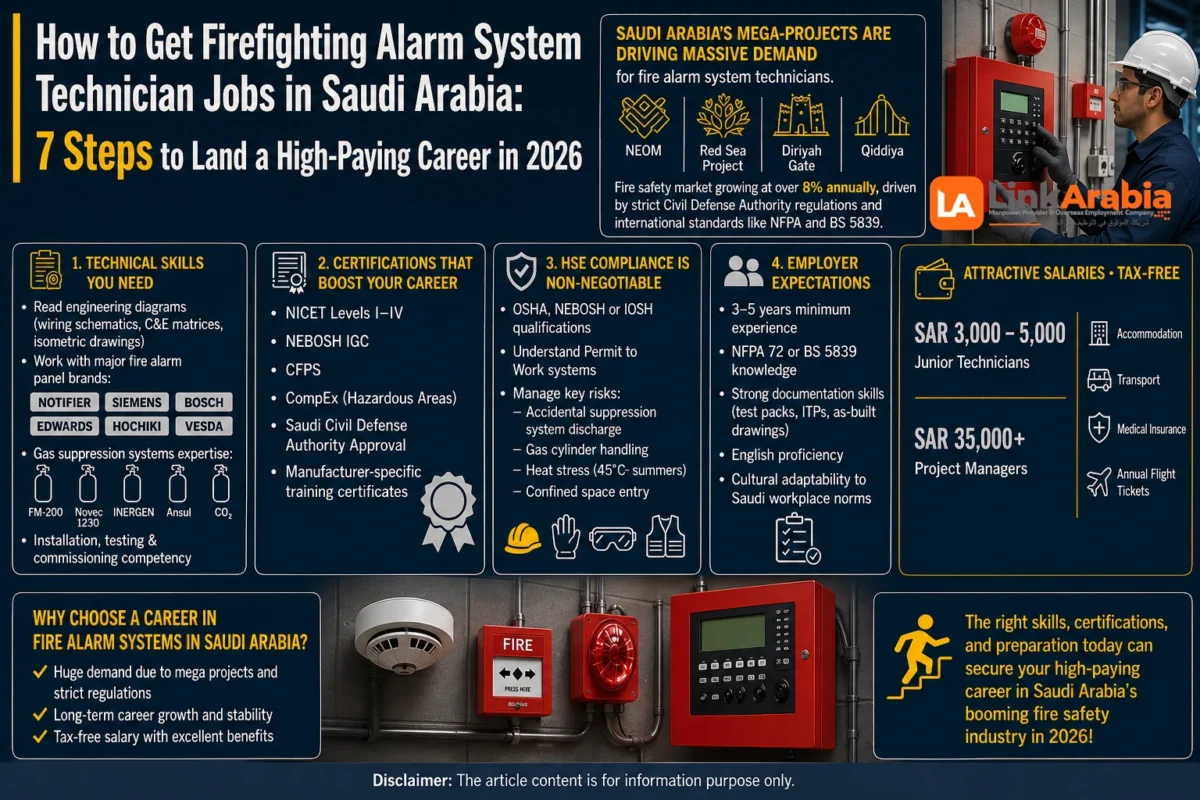
Saudi Arabia’s Vision 2030 initiative has triggered one of the largest construction booms in modern history. Mega-projects such as NEOM, the Red Sea Project, Diriyah Gate, and Qiddiya are reshaping the kingdom’s skyline — and every single building, tunnel, hotel, hospital, and industrial facility requires certified fire alarm and suppression systems. For skilled firefighting alarm system technicians, this translates into thousands of job opportunities with competitive, tax-free salaries, accommodation allowances, and fast career progression.
This comprehensive guide walks you through every aspect of building a successful career as a fire alarm system technician in Saudi Arabia — from the essential technical skills and internationally recognized systems to HSE requirements and what Saudi employers actually look for.
The fire safety and suppression systems market in Saudi Arabia is projected to grow at a compound annual growth rate of over 8% through 2030. Demand is driven by strict enforcement of the Saudi Civil Defense Authority (SCDA) regulations, the General Directorate of Civil Defense (GDCD) codes, and international standards such as NFPA, BS 5839, and SFPE.
Key industries hiring fire alarm technicians include:
- Oil & Gas (Saudi Aramco, SABIC, NEOM industrial zones)
- Hospitality & Tourism (Red Sea Project, luxury hotels)
- Healthcare (hospital fire suppression and detection systems)
- Commercial real estate (Riyadh, Jeddah, Dammam high-rises)
- Industrial & Manufacturing (petrochemical plants, warehouses)
- Government and military infrastructure
2. Essential Skillset for Firefighting Alarm System Technicians
Saudi employers — whether they are MEP contractors, system integrators, or facility management companies — expect a well-rounded technician capable of both technical execution and documentation. Below is a detailed breakdown of the critical skills required.
2.1 Reading and Interpreting Engineering Diagrams
The ability to read, understand, and work from technical drawings is non-negotiable. Technicians must be proficient in:
- Fire alarm loop drawings and panel wiring schematics
- Cause and effect matrices (C&E charts)
- Single-line and multi-line diagrams
- Isometric drawings for suppression system piping
- As-built drawings and shop drawing mark-ups
- AutoCAD and Revit MEP drawings (reading level minimum)
- Cable routing and termination schedules
- Panel layout and zone configuration drawings
2.2 Fire Alarm Panel Systems — Technical Proficiency
Technicians must have hands-on experience with at least one or more of the major fire alarm control panel (FACP) manufacturers. Addressable and conventional systems are both in use across Saudi Arabia, with addressable systems now mandated in most large-scale projects.
Major Fire Alarm System Brands Used in Saudi Arabia & Middle East
✔ Notifier (Honeywell) — NFS2-3030, NFW2-100 — Extremely common across KSA |
✔ Siemens — Cerberus PRO, FC72x, FV2009 — Used in premium commercial & industrial projects |
✔ Edwards / UTC Fire & Security — EST3, EST4 — Widely used in hospitality and healthcare |
✔ Bosch — FPA-5000, FPA-1200 — Preferred in European contractor-led projects |
✔ Apollo Fire Detectors — Discovery, XP95 — Widely used with multiple panel brands |
✔ Hochiki — CLIP, ESP — Common in hotels and commercial buildings |
✔ Hochiki America — E2S, FIRElink — Distributed across GCC region |
✔ Napco Security / FireShield — Used in smaller commercial installations |
✔ VESDA (Xtralis / Honeywell) — Very Early Smoke Detection Apparatus — Data centers, clean rooms |
✔ Protectowire — Linear Heat Detection — Petrochemical, tunnels, cable trays |
2.3 Gas Suppression and Special Hazard Systems
Beyond conventional fire alarm systems, Saudi Arabia’s industrial and data center sectors rely heavily on clean agent and gas suppression systems. Technicians with expertise in these systems command significantly higher salaries:
Gas Suppression Systems — Knowledge Required in Saudi Arabia |
✔ FM-200 (HFC-227ea) — Heptafluoropropane — Most widely used clean agent in Saudi Arabia for server rooms, switch gear rooms, and archives |
✔ Novec 1230 (3M / Johnson Controls) — Environmentally preferred clean agent, fast adoption in KSA mega-projects |
✔ INERGEN (Ansul) — Inert gas blend (N₂, Ar, CO₂) — Used in occupied spaces such as control rooms |
✔ CO₂ Suppression Systems — Industrial kitchen hoods, engine rooms, generator rooms |
✔ Halon Replacement Systems — Legacy system maintenance still required in older plants |
✔ Ansul R-102 / LVS — Wet chemical kitchen suppression systems — Hotels, restaurants |
✔ Ansul AUTOPULSE — Control system integration for suppression systems |
✔ PyroGen Condensed Aerosol — Electrical cabinets, marine applications |
✔ Water Mist Systems (Marioff HI-FOG) — Museum, archive, heritage site protection |
✔ Pre-action Sprinkler Systems — Data centers and freezer warehouses |
2.4 Firefighting Detection Devices — Component-Level Knowledge
- Photoelectric and ionization smoke detectors
- Multi-sensor detectors (smoke + heat + CO)
- Heat detectors — fixed temperature and rate-of-rise
- Flame detectors — UV, IR, multi-spectrum
- Gas detection systems — LEL, H₂S, CO, toxic gas
- Beam smoke detectors (open-path)
- Aspirating smoke detectors (ASD) — VESDA, FAAST
- Manual call points (MCP) and input/output modules
- Sounders, strobes, and voice evacuation systems (EVAC)
- Pressure switches, flow switches, and tamper switches
2.5 Installation, Testing, and Commissioning Skills
- Cable pulling and conduit installation (EMT, rigid, flexible)
- Panel programming and zone configuration
- Loop fault finding using test equipment (Multimeter, Meggering, LCIE tester)
- Functional testing and factory acceptance tests (FAT)
- Site acceptance testing (SAT) documentation
- Cause and effect verification testing
- Commissioning and handover documentation
- Preventive maintenance and annual inspection procedures
2.6 Software and Digital Tools
- Fire alarm panel configuration software (e.g., Notifier SWIFT, Siemens SIGMASYS)
- BMS/BAS integration and interface knowledge
- Microsoft Office — Word, Excel for reports, punch lists, test records
- AutoCAD (reading level) for as-built drawings
- CMMS (Computerized Maintenance Management Systems)
3. Internationally Recognized Certifications That Saudi Employers Value
While a degree in electrical engineering or electronics is helpful, Saudi employers place significant weight on hands-on experience and internationally recognized certifications. The following qualifications dramatically improve your employability and salary potential:
Certification | Issuing Body | Relevance |
NICET Fire Alarm Systems Level I–IV | NICET, USA | Highly regarded in KSA projects using US specs |
CFPS — Certified Fire Protection Specialist | NFPA, USA | Essential for design and senior technical roles |
FIA (Fire Industry Association) Technician Cert | FIA, UK | Valued in UK contractor-led projects |
CompEx — Explosive Atmospheres | CompEx, UK | Required for oil & gas / hazardous area work |
NEBOSH Fire Safety Certificate | NEBOSH, UK | HSE and fire safety management |
Saudi Civil Defense Authority Approval | SCDA / GDCD, KSA | Mandatory for working on SCDA-approved systems |
Manufacturer Training Certificates | Notifier / Siemens / Bosch etc. | Vendor-specific system commissioning |
CCTV & ELV Integration Awareness | Various | Added value for integrated life safety projects |
4. Health, Safety & Environment (HSE) — Critical Compliance for Saudi Arabia
Saudi Arabia enforces strict HSE regulations on all construction and industrial sites. Failure to comply can result in immediate work permit cancellation, deportation, or criminal liability. Fire alarm technicians must be fully conversant with the following HSE frameworks and site safety practices.
4.1 Saudi HSE Regulatory Bodies
- General Directorate of Civil Defense (GDCD) — Primary fire safety authority
- Saudi Civil Defense Authority (SCDA) — System design and installation approvals
- Ministry of Human Resources & Social Development — Worker protection regulations
- Saudi Aramco SAES Standards — Mandatory on Aramco-affiliated sites
- Royal Commission for Jubail & Yanbu (RCJY) HSE — Industrial city regulations
4.2 Mandatory HSE Certifications for Site Access
- OSHA 10 or OSHA 30 — Occupational Safety & Health Administration (USA)
- NEBOSH IGC — International General Certificate — Widely required in KSA
- IOSH Managing Safely — Required by many MEP and FM contractors
- First Aid & CPR Certificate — Mandatory on most large sites
- Confined Space Entry Training — Essential for cable trench and basement work
- Working at Heights (WAH) Certification — For ceiling and high-bay installations
- Lockout/Tagout (LOTO) Awareness — Electrical safety during panel work
- Permit to Work (PTW) System knowledge — Hot work, electrical isolation, confined space
4.3 HSE Risks Specific to Fire Alarm Technicians
Working in fire alarm and suppression systems carries unique HSE risks that technicians must proactively manage:
- Electrical hazards — Panel wiring, SLU (short loop units), 24VDC bus faults
- Gas suppression system accidental discharge — FM-200 / CO₂ — risk of asphyxiation
- High-pressure cylinder handling — Nitrogen, CO₂, FM-200 cylinders require trained handling
- Working in confined spaces — Risers, plant rooms, basements
- Height and fall risks — Ceiling installations, atrium detectors, beam detectors
- Noise and chemical exposure — Soldering, cable insulation, VOC from cleaning agents
- Heat stress — Outdoor cable routing in Saudi summers (temperatures exceeding 45°C)
- Manual handling — Heavy panel boards, cylinder racks, cable drums
4.4 HSE Best Practices on Saudi Sites
- Always carry a valid site induction card and HSE passport
- Use appropriate PPE — hard hat, safety shoes, high-vis vest, safety glasses, gloves
- Never discharge a suppression system without full authorization and area clearance
- Complete a Job Hazard Analysis (JHA) or Task Risk Assessment (TRA) before each task
- Report all near-misses and incidents through the site HSE reporting system
- Maintain an up-to-date equipment inspection register (EIR)
- Ensure all tools are color-coded and inspected per site quarterly schedule
5. What Saudi Arabian Employers Expect from Fire Alarm System Technicians
Understanding employer expectations is the key to writing a winning CV, acing interviews, and securing rapid promotions. Saudi employers — ranging from large EPC contractors to boutique MEP companies — share consistent expectations across the industry.
5.1 Technical Competency Expectations
- Minimum 3–5 years of hands-on fire alarm system experience (junior to mid-level roles)
- Proven commissioning experience with at least one major brand (Notifier, Siemens, or Bosch)
- Ability to independently fault-find addressable loop faults and troubleshoot panel errors
- Familiarity with NFPA 72 (National Fire Alarm and Signaling Code) or BS 5839
- Understanding of NFPA 2001 for clean agent systems or NFPA 12 for CO₂ systems
- Experience with cause and effect testing (C&E) and integrated system testing (BMS, access control, CCTV, ELV)
- Ability to prepare and submit As-Built documentation and O&M manuals
5.2 Documentation and Reporting Expectations
Saudi project managers and PMC (Project Management Consultants) are documentation-intensive. Technicians who can produce clear, accurate technical records are fast-tracked for supervisory roles:
- Daily work reports and manpower allocation records
- Test packs, commissioning checklists, and ITPs (Inspection and Test Plans)
- Punch list management and close-out tracking
- Material submittals and approval documentation
- Method statements and risk assessments
5.3 Soft Skills and Workplace Expectations
- English language proficiency — Written and spoken (essential for all client-facing roles)
- Arabic language — An advantage, particularly for GDCD inspection liaison
- Team-oriented attitude — Saudi projects involve large multi-national teams
- Ability to work under pressure and meet project milestones
- Respect for Saudi cultural norms and Islamic working practices (prayer times, Ramadan scheduling)
- Flexibility to work overtime and weekends during project crunch periods
- Valid driving license — Preferred for site-to-site travel between project locations
5.4 Salary Expectations in Saudi Arabia (2025)
Position Level | Monthly (SAR) | Monthly (USD approx.) |
Junior Technician (0–3 yrs) | 3,000 – 5,000 | $800 – $1,350 |
Mid-Level Technician (3–6 yrs) | 5,000 – 8,500 | $1,350 – $2,270 |
Senior Technician / Foreman (6–10 yrs) | 8,500 – 14,000 | $2,270 – $3,730 |
Lead Commissioning Engineer | 14,000 – 20,000 | $3,730 – $5,330 |
Fire Alarm Project Manager / Specialist | 20,000 – 35,000+ | $5,330 – $9,330+ |
Note: Packages typically include accommodation, transportation, medical insurance, and annual air ticket — substantially increasing the total compensation value. (just for references purposes only)
6. Steps to Get a Fire Alarm Technician Job in Saudi Arabia
Step 1 — Build a Strong, Keyword-Rich CV
Your CV must highlight specific system brands, NFPA codes, and project scale. Saudi recruiters search for keywords like ‘Notifier commissioning,’ ‘FM-200 technician,’ ‘NFPA 72,’ and ‘addressable system.’ Tailor your CV for each application and include specific project references with scope and value.
Step 2 — Obtain Relevant Certifications
At minimum, secure a NICET Level I or II, a manufacturer training certificate from Notifier, Siemens, or Bosch, and an HSE certification such as NEBOSH IGC or OSHA 30 before applying. These open the door to reputable employers.
Step 3 — Contact Licensed Recruitment Agencies in Pakistan
Pakistan has a well-established network of government-licensed recruitment agencies that specialize in placing fire alarm, MEP, and ELV technicians in Saudi Arabia and across the Gulf region. These agencies maintain direct relationships with Saudi employers, MEP contractors, and facility management companies, making them one of the fastest and most reliable routes to securing overseas employment.
To make the most of this channel:
- Visit recruitment agencies that are officially licensed by the relevant Pakistani government emigration authority and specifically handle Gulf technical and engineering placements
- Prioritize agencies that have a proven track record of placing fire alarm, ELV, or MEP technicians in Saudi Arabia rather than general labor recruiters
- Always verify the agency’s license status through the official government channels.
- Carry certified copies of all your technical certificates, experience letters, and passport when visiting agencies, as Saudi employers often request document verification at the recruitment stage
Connecting with the right licensed agency significantly reduces your job search time and ensures you are protected under a legal, government-verified employment contract.
Conclusion
Saudi Arabia’s construction and industrial expansion under Vision 2030 has created a sustained, high-demand market for qualified firefighting alarm system technicians. Whether you specialize in addressable fire detection, FM-200 clean agent systems, VESDA aspirating smoke detection, or integrated life safety platforms, there is a lucrative career waiting for skilled and certified professionals.
The formula for success is straightforward: invest in recognized certifications (NICET, NEBOSH, manufacturer training), develop deep system-specific expertise across leading brands like Notifier, Siemens, and Bosch, maintain a rigorous HSE mindset, and proactively market yourself through Gulf job portals and industry networks.
With tax-free salaries, generous allowances, and accelerated career progression, Saudi Arabia remains one of the most rewarding destinations globally for fire alarm system technicians. Start building your profile today — Vision 2030 is just getting started.