
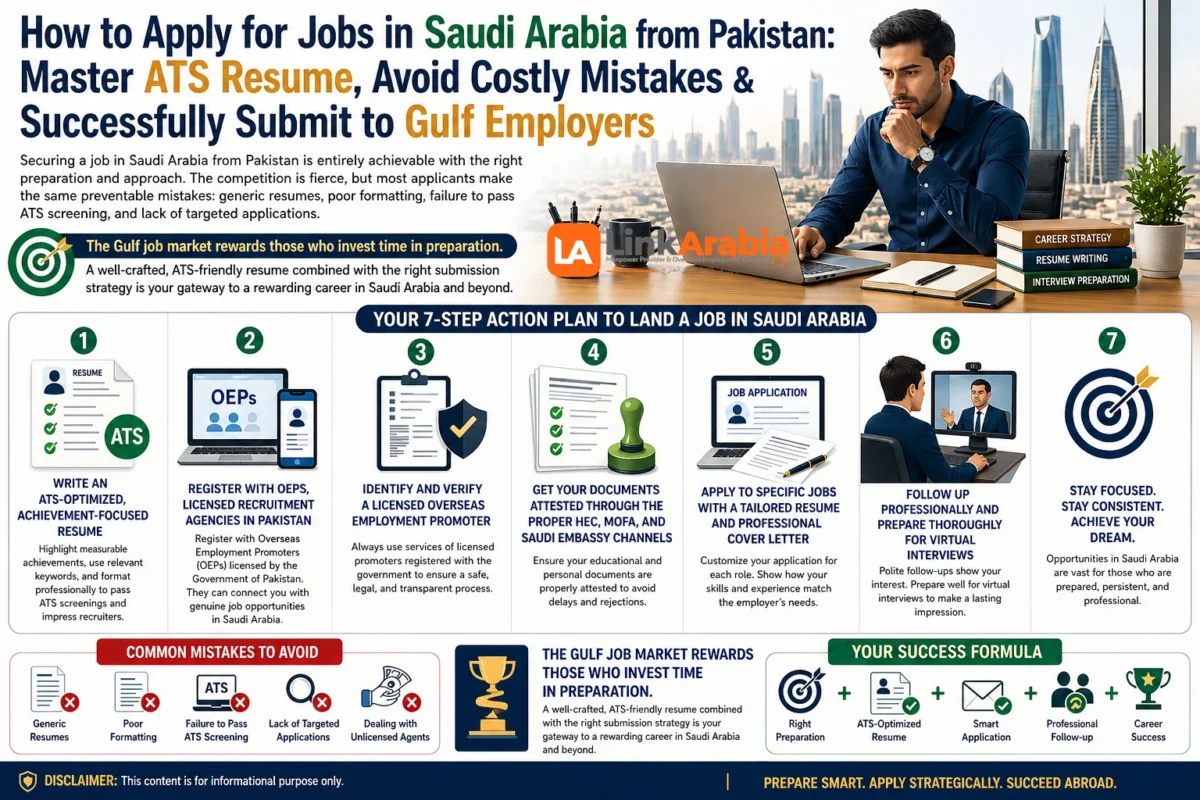
How to Apply for Jobs in Saudi Arabia from Pakistan: Master ATS Resume, Avoid Costly Mistakes & Successfully Submit to Gulf Employers
Every year, hundreds of thousands of Pakistanis dream of securing a better future in Saudi Arabia and the broader Gulf region. The Gulf Cooperation Council (GCC) countries, including Saudi Arabia, the United Arab Emirates, Qatar, Kuwait, Bahrain, and Oman, remain among the top destinations for Pakistani job seekers due to higher salaries, tax-free income, and abundant opportunities in sectors like construction, engineering, IT, healthcare, hospitality, and skilled trades.
Yet, despite tremendous talent and qualifications, many Pakistanis fail to land interviews, not because they lack skills, but because their resume does not meet modern hiring standards. Best Recruiters in Saudi Arabia and across the Gulf increasingly rely on Applicant Tracking Systems (ATS) to filter candidates before a human even reads a single line. A poorly formatted resume or one full of common mistakes can eliminate you from consideration within seconds.
This comprehensive guide will walk you through everything you need to know: what a resume is and why it matters, what an ATS resume is and how to build one, the most common mistakes Pakistani job seekers make when applying to Saudi Arabian positions, and a practical, step-by-step process for submitting your resume to Gulf employers directly from Pakistan.
A resume is a formal, written document that presents your professional identity to a potential employer. It is a structured summary of your education, work experience, skills, certifications, and achievements, designed to convince a hiring manager that you are the right candidate for a specific job.
The word resume comes from the French word meaning ‘summary,’ and that is precisely what it is: a concise, powerful snapshot of your career story. Unlike a detailed curriculum vitae (CV), which is common in academic and research settings and can run many pages, a professional resume for industry jobs is typically one to two pages long
What Does a Resume Include?
A well-structured resume contains the following core sections:
- Contact Information: Your full name, phone number (with country code), professional email address, city/country of residence, and optionally your LinkedIn profile URL.
- Professional Summary or Objective: A 3-5 line paragraph at the top that describes who you are professionally, your key skills, and what value you bring to the employer.
- Work Experience: A reverse-chronological list of your jobs, including job title, company name, location, dates of employment, and bullet points describing your responsibilities and measurable achievements.
- Education: Your degrees, diplomas, and certifications, including institution name, degree title, and graduation year.
- Skills: A curated list of technical and soft skills relevant to the job you are applying for.
- Certifications and Licenses: Professional certifications such as PMP, IELTS, NEBOSH, Saudi Commission for Health Specialties (SCHS) registration, or trade licenses.
- Languages: Especially important for Gulf jobs – Arabic proficiency is a major advantage.
- References: Usually stated as ‘Available upon request’ in modern resumes.
Why Your Resume Is the Most Important Document in Your Job Search
In competitive job markets like Saudi Arabia, a recruiter may receive hundreds or even thousands of applications for a single position. Your resume is your first and often only chance to make an impression. Studies consistently show that recruiters spend an average of six to eight seconds on an initial resume scan before deciding to read further or discard it.
This means your resume must immediately communicate your value, be visually clean and readable, match the requirements of the job, and pass through automated screening systems. A strong resume is not just a list of things you have done; it is a targeted marketing document crafted to speak directly to what the employer needs.
What Is an ATS Resume?
ATS stands for Applicant Tracking System. It is software used by employers and recruitment agencies to receive, sort, filter, and rank job applications before any human reviews them. In Saudi Arabia and across the Gulf region, large corporations, government-linked companies (such as Saudi Aramco, SABIC, STC, Emaar, and ADNOC), and international recruitment firms almost universally use ATS platforms.
When you submit your resume online through a company portal, a job board, or even via email to a large HR department, your resume is typically first processed by an ATS. The system scans your document for specific keywords, skills, job titles, and qualifications that match the job description. If your resume does not meet the system’s criteria, it is automatically rejected before any recruiter sees it.
Research suggests that up to 75% of resumes submitted online are rejected by ATS software before reaching a human hiring manager. This is the single biggest invisible barrier facing Pakistani job seekers applying to Gulf positions.
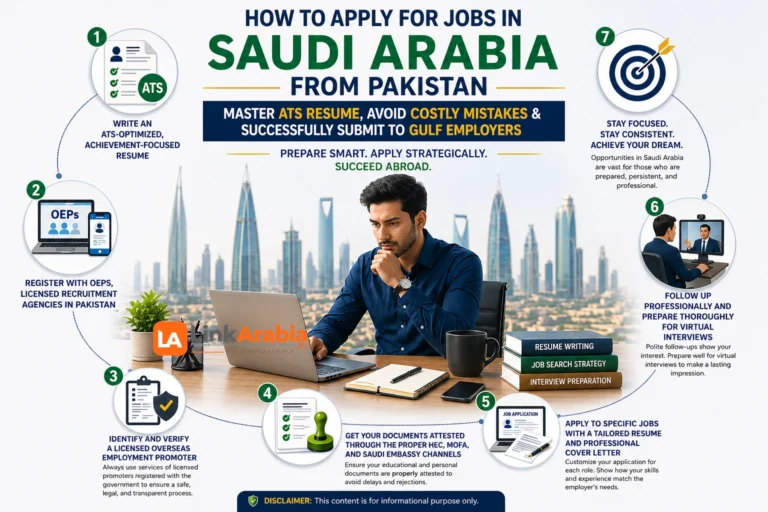
How ATS Software Works
- Resume Parsing: The ATS breaks down your resume into data fields, extracting your name, contact details, education, work history, and skills.
- Keyword Matching: The system compares your resume content against the keywords in the job description. If the job requires ‘civil engineering,’ ‘AutoCAD,’ or ‘ISO 9001,’ your resume needs to contain those exact terms.
- Scoring and Ranking: Candidates are scored and ranked based on how closely their resume matches the job requirements.
- Human Review: Only the top-scoring resumes, typically the top 10-20%, are forwarded to a recruiter for human review.
What Makes a Resume ATS-Friendly?
To pass ATS screening successfully, your resume must follow specific formatting and content rules:
- Use Standard Fonts: Stick to universally readable fonts such as Calibri, Arial, Times New Roman, or Cambria. Fancy or decorative fonts may not be read correctly by ATS parsers.
- Avoid Graphics and Tables: Images, logos, text boxes, and tables can confuse ATS software and cause important information to be lost during parsing.
- Use Standard Section Headings: Label your sections clearly using conventional titles like ‘Work Experience,’ ‘Education,’ ‘Skills,’ and ‘Certifications.’ Creative labels like ‘My Journey’ or ‘What I Bring’ are not recognized by ATS.
- Incorporate Job-Specific Keywords: Read the job description carefully and mirror its language in your resume. If it says ‘project management,’ use that exact phrase, not just ‘managing projects.’
- Use a Clean, Single-Column Layout: Multi-column layouts look attractive in PDF viewers but confuse ATS parsers. A single-column format ensures the system reads your resume in the correct order.
- Save in the Right File Format: Most ATS systems prefer .docx or .pdf formats. Unless the employer specifies otherwise, submitting in .docx is generally the safest option for ATS compatibility.
- Avoid Headers and Footers for Critical Information: Some ATS systems cannot read text placed in the header or footer of a document. Your name and contact information should be in the main body of the resume.
- Use Full Spellings: Avoid abbreviations the ATS may not recognize. Write ‘Human Resources’ not just ‘HR,’ ‘Information Technology’ not just ‘IT,’ at least once.
ATS vs. Human-Readable Resume: Striking the Balance
The goal is to create a resume that satisfies both the ATS and the human reader who reviews it afterward. An ATS-optimized resume stuffed with keywords but lacking coherent sentences and compelling achievements will fail at the human review stage. Conversely, a beautifully designed, graphically rich resume may impress the eye but never reach a human reviewer because it failed the ATS.
The solution is a clean, professionally written, keyword-rich resume that presents your experience in clear, achievement-focused bullet points. This is the standard you must aim for when applying to Saudi Arabian and Gulf employers.
Common Mistakes Pakistani Job Seekers Make When Applying for Jobs in Saudi Arabia
Understanding what not to do is just as important as knowing best practices. Based on feedback from Gulf recruiters and HR professionals, here are the most common and damaging resume mistakes made by Pakistani applicants targeting Saudi Arabia and the broader Gulf market.
Mistake 1: Using an Outdated or Overly Decorated Resume Template
Many Pakistani job seekers rely on heavily designed templates with colorful sidebars, profile photos, rating bars for skills, and decorative icons. While these may look impressive on a computer screen, they are extremely problematic for ATS software. The parser cannot distinguish between a skill bar at 80% and one at 60%, and it may skip entire sections placed in sidebar columns. Stick to a clean, simple, single-column layout.
Mistake 2: Including a Photo on the Resume
In Pakistan and South Asia, including a photograph on a resume is common practice. However, for international applications, especially in Western-influenced multinational environments increasingly common in Saudi Arabia, a photo on a resume can lead to bias and is generally unnecessary. More critically, ATS systems cannot process images at all, which may cause the system to misparse your resume. Unless specifically requested by the employer, leave the photo out.
Mistake 3: Listing Responsibilities Instead of Achievements
One of the most widespread weaknesses in Pakistani resumes is describing what you were supposed to do rather than what you actually accomplished. Writing ‘Responsible for managing a team’ tells an employer nothing memorable. Writing ‘Led a 12-member team to complete a SAR 5 million construction project 3 weeks ahead of schedule’ demonstrates real value. Quantify your achievements wherever possible using numbers, percentages, and monetary figures.
Mistake 4: Using a Generic Resume for Every Job
Sending the same resume to every employer is a guaranteed path to the rejection pile, especially in ATS-screened environments. Every job description contains specific keywords and requirements. If you apply for a mechanical engineer role at Saudi Aramco, your resume should be tailored to highlight your mechanical engineering skills, relevant certifications, upstream or downstream oil and gas experience, and safety qualifications. A one-size-fits-all resume will have a low keyword match score and be ranked out of consideration.
Mistake 5: Poor Formatting of Dates and Job Titles
Inconsistent date formats (e.g., mixing ‘2019-2021’ with ‘Jan 19 to Dec 21’), missing dates, or gaps in employment left unexplained raise red flags for both ATS systems and human recruiters. Use a consistent date format throughout, such as ‘January 2019 – March 2022,’ and briefly address any significant employment gaps.
Mistake 6: Ignoring Saudi-Specific Requirements
Saudi Arabia has unique requirements that differ from other Gulf states and international markets. These include Iqama (residency permit) status, which matters to employers, SCHS registration for healthcare professionals, MOMRA accreditation for engineers, Saudi Council of Engineers membership, and Saudi Aramco or SABIC pre-qualification requirements for technical roles. Failing to mention relevant Saudi-specific certifications or registrations can immediately disqualify your application.
Mistake 7: Weak or Missing Professional Summary
Many Pakistani resumes jump straight into work experience without a professional summary. A well-crafted 3-5 line professional summary at the top of your resume serves as an elevator pitch. It should include your years of experience, your area of expertise, your key skills, and what you are seeking. This section is the first thing a recruiter reads after your name and must compel them to continue reading.
Mistake 8: Spelling and Grammar Errors
This may seem obvious, but spelling mistakes, grammatical errors, and poor sentence structure remain surprisingly common in resumes sent to Gulf employers. English is the primary language of business in Saudi Arabia’s multinational corporate environment. Errors in your resume signal carelessness and poor communication skills, two traits no employer wants. Always proofread your resume multiple times and use tools like Grammarly before submitting.
Mistake 9: Not Including a Saudi Arabia or GCC Phone Number
If you are already in Saudi Arabia or the Gulf on a visit or work visa, include a local contact number. If you are applying from Pakistan, include your Pakistan number with the full international dialing code (+92). Ensure your number is reachable during Saudi Arabia business hours, which run Sunday through Thursday.
Mistake 10: Overly Long Resumes
Pakistani job seekers, particularly those with many years of experience, often submit resumes of four, five, or even eight pages. For most industry positions in Saudi Arabia, a resume should be one to two pages. For senior management and executive roles, three pages is the absolute maximum. Trim irrelevant details, old jobs from more than fifteen years ago, and obvious skills to keep your resume concise and impactful.
How to Submit Your Resume to Gulf Employers from Pakistan
Knowing how to write a great resume is only half the battle. The other half is knowing how and where to submit it effectively. Pakistan has a large overseas job market infrastructure that you can leverage, and understanding the official and practical channels will significantly increase your chances of success.
Identify Target Jobs and Companies
Before sending a single application, research the Gulf job market relevant to your profession. Identify specific companies and specific positions you are qualified for. Do not scatter applications randomly. A targeted approach with customized resumes will always outperform mass applications with a generic resume.
Key sectors currently in high demand in Saudi Arabia include:
- Vision 2030 mega-projects: NEOM, Red Sea Project, Diriyah Gate, Qiddiya
- Oil and gas: Saudi Aramco, SABIC, Halliburton, Schlumberger
- Healthcare: Hospitals under MOH, NGHA, private hospital groups
- Construction and infrastructure: Saudi Binladin Group, Bechtel, Larsen & Toubro
- IT and telecommunications: STC, Mobily, Cisco, IBM Saudi Arabia
- Hospitality: Movenpick, Accor , Hilton, Marriott, Four Seasons, Rotana
Engage with Licensed Overseas Employment Promoters (OEPs)
Licensed OEPs are recruitment agencies in Pakistan that have contracts with Gulf employers and are legally authorized to recruit workers for overseas employment. They can match your profile with job demands in Saudi Arabia and facilitate the visa process.
What Exactly Are OEPs?
Licensed Overseas Employment Promoters are private recruitment agencies registered and regulated by the Bureau of Emigration and Overseas Employment (BEOE) under Pakistan’s Emigration Ordinance 1979. These agencies have formal agreements, known as demand letters or manpower supply agreements, with employers in Gulf countries including Saudi Arabia, the UAE, Qatar, Kuwait, Bahrain, and Oman.
OEPs act as the official bridge between Pakistani workers and Gulf employers. When a Saudi company needs to hire 50 electricians, 10 civil engineers, or 200 construction workers from Pakistan, they contact a licensed OEP in Pakistan, send an official demand letter, and authorize the agency to recruit on their behalf. The OEP then advertises the positions, screens candidates, conducts initial interviews, and forwards selected profiles to the employer for final approval.
Without an OEP or direct employer contact, it is legally and practically very difficult for a Pakistani national to obtain a work visa for Saudi Arabia, particularly for mid-level and blue-collar positions. This makes OEPs a genuinely valuable resource when they are legitimate and properly licensed.
Conclusion
Securing a job in Saudi Arabia from Pakistan is entirely achievable with the right preparation and approach. The competition is fierce, but most applicants make the same preventable mistakes: generic resumes, poor formatting, failure to pass ATS screening, and lack of targeted applications.
Your action plan should be:
- Write an ATS-optimized, achievement-focused resume tailored to your target industry.
- Register on major Gulf job portals and optimize your LinkedIn profile.
- Identify and apply through a licensed overseas employment promoter .
- Get your documents attested through the proper HEC, MOFA, and Saudi Embassy channels.
- Apply to specific jobs with a tailored resume and professional cover letter.
- Follow up professionally and prepare thoroughly for virtual interviews.
The Gulf job market rewards those who invest time in preparation. A well-crafted, ATS-friendly resume combined with the right submission strategy is your gateway to a rewarding career in Saudi Arabia and beyond. Take the time to do it right, and your chances of success will increase dramatically.