
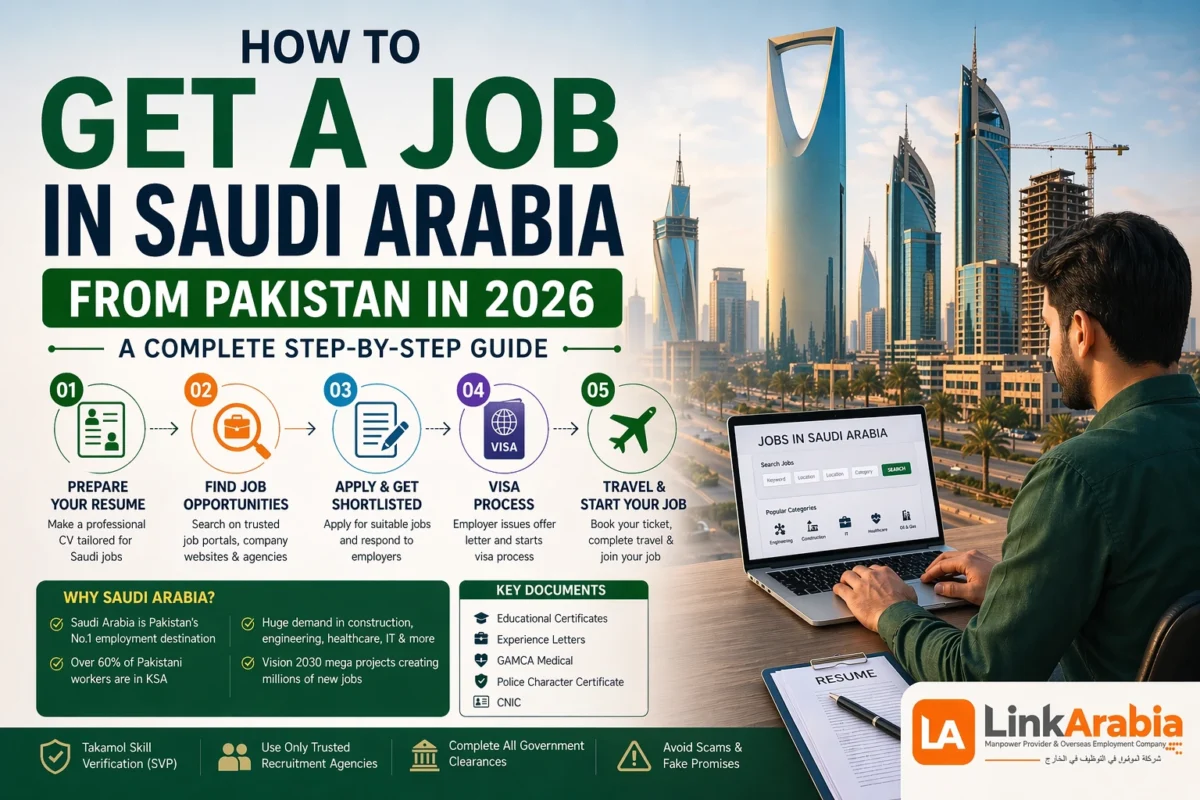
How to Get a Job in Saudi Arabia from Pakistan in 2026: A Complete Step-by-Step Guide
Saudi Arabia remains the single largest employment destination for Pakistani workers, year after year. Whether you are a skilled tradesman from Rawalpindi, an engineer from Lahore, a healthcare professional from Karachi, or a fresh IT graduate from Islamabad , the Kingdom of Saudi Arabia continues to offer life-changing employment opportunities that are simply unavailable at home. With Vision 2030 reshaping every corner of the Saudi economy, the demand for Pakistani talent across construction, engineering, healthcare, IT, and services is at a historic high.
But knowing how to navigate the process correctly from skill verification to visa categories, from choosing the right recruitment agency to completing mandatory government clearances is what separates candidates who land genuine, well-paying jobs from those who get misled, exploited, or stuck. This guide walks you through every step, with Saudi Arabia at the centre of every discussion.
Saudi Arabia alone accounts for over 60% of all Pakistani overseas employment. The bilateral relationship between the two countries is one of the most robust in the world, covering labour cooperation agreements, preferential processing arrangements, and direct government-to-government engagement on workforce supply. Saudi Arabia was also the first country to sign a formal Skill Verification Program agreement with Pakistan something no other destination country has done which speaks to how seriously the Kingdom takes Pakistani workers as a strategic talent source.
Saudi Arabia’s ongoing mega-projects under Vision 2030 have completely transformed the country’s hiring landscape. NEOM, the futuristic city being built from scratch in the Tabuk region, the Red Sea Project, Diriyah Gate, Qiddiya city, and hundreds of infrastructure contracts linked to Vision 2030 have created unprecedented demand for manpower at every skill level. At the same time, the Kingdom’s push to become a global health, education, and tourism destination has opened white-collar opportunities that did not exist even five years ago.
For Pakistani workers, the timing has never been better provided the process is done correctly.
Step 1: Identify the Right Job and Region in Saudi Arabia
One of the first things Pakistani job seekers get wrong is assuming that Saudi Arabia’s opportunities are concentrated in just one or two cities. The reality in 2026 is quite the opposite — the Kingdom’s economic transformation under Vision 2030 has created parallel booms across every major region simultaneously, meaning that whether you are a tradesman, a professional, or a fresh graduate, there is active hiring happening in a city that suits your background.
Riyadh, the administrative and financial capital, is a powerhouse for construction, engineering, IT, corporate services, finance, and administration — but it is equally home to thriving hospitality, healthcare, and retail sectors that are expanding rapidly as the city positions itself as a global destination. Jeddah, Saudi Arabia’s commercial gateway, is synonymous with trade, logistics, and FMCG, yet it simultaneously hosts some of the Kingdom’s most active construction and MEP projects, a booming healthcare corridor, and a hospitality workforce that is growing faster than almost any other sector as pilgrimage and leisure tourism converge. Dammam, Al Khobar, and Dhahran in the Eastern Province are world-renowned for oil, gas, and petrochemicals through Aramco and SABIC — but the same region has significant demand for healthcare professionals, civil construction crews, IT specialists, and logistics operators serving its dense industrial population. The NEOM and Tabuk Region, while still associated primarily with mega-scale construction, is already generating demand for hospitality, facilities management, smart technology, and environmental services as its first operational phases come to life.
The practical takeaway is this: do not limit your search to a single city based on a general impression of where your trade belongs. Engineers get placed in Jeddah. Welders work in Riyadh. Nurses find contracts in Dammam. The opportunity map is wider than most candidates realise.
What matters far more than geography at the application stage is timing — and that is where candidates serious about Saudi employment need to build one critical daily habit. Licensed recruitment agencies in Pakistan receive government-approved manpower demands from Saudi employers on a continuous basis. These demands are official vacancy notifications — verified by the Pakistani Ministry of Overseas Pakistanis and Human Resource Development, tied to real employers, and processed through the proper legal framework. Checking these daily postings through licensed agencies is one of the most direct and reliable ways to find genuine Saudi employment opportunities, often before they are ever listed on any job portal.
Make it a habit to monitor the active vacancy lists of licensed agencies operating in your city — Rawalpindi, Lahore, Karachi, Peshawar, or Multan and list goes on — and respond quickly when a Government approved demand matches your trade or profession, because government-approved quotas are filled on a first-come, first-served basis.
Step 2: Get Your Documents in Order / Documents Required for Saudi Work Visa
This is the step most candidates underestimate, and it is the one that causes the most delays. The Saudi Embassy is strict about documentation, and incomplete or incorrectly attested papers result in visa rejections that waste months. Prepare every document before you even begin applying.
Passport: Valid for at least six months beyond your intended date of travel. If it expires within that window, renew it first.
CNIC: The foundation of your Pakistani legal identity. Ensure it is not expired.
Educational Certificates: Degree-level qualifications must be attested by HEC (Higher Education Commission), then by the Ministry of Foreign Affairs (MOFA) in Islamabad, and finally by the Saudi Embassy. This multi-step attestation process typically takes three to four weeks and should be started at the very beginning of your job search — not after you receive an offer.
Experience Letters: Formal letters from previous employers on official letterhead confirming your designation, dates of employment, and key responsibilities. Saudi employers verify these carefully for technical and professional roles.
Medical Fitness Certificate: All workers proceeding to Saudi Arabia are required to complete a GAMCA (Gulf Approved Medical Centers Association) medical examination at a GAMCA-approved clinic in Pakistan. The medical results are submitted electronically to the Saudi immigration system. GAMCA clinics are present in all major Pakistani cities.
Police Character Certificate: Obtainable from your local police station or through the NADRA portal. and it must be attested from MOFA.
Step 3: Takamol Skill Verification — Now Mandatory for Semi-Skilled and Skilled Trades
This is the step that many candidates particularly those returning for repeat contracts are not fully aware of, and missing it will result in a visa rejection at the Saudi Embassy.
Pakistan was the first country to formally sign an agreement with Takamol, a Saudi government-authorised agency, for the implementation of the Skills Verification Program (SVP). The program was launched by Saudi Arabia on 1 July 2021 as part of its efforts to regulate the labour market. ARY News
It is mandatory for all Pakistani skilled workers to obtain the skill verification certificate from Takamol, which conducts tests in Pakistan through NAVTTC, to travel to Saudi Arabia on a work visa. Pakistan Observer What is critically important for 2026 is that this requirement now extends to semi-skilled trades as well not just the highly skilled. Electricians, plumbers, welders, HVAC technicians, auto mechanics, carpenters, scaffolders, and many other trades are all covered under the mandatory SVP framework.
Under this program, all skilled workers from Pakistan and other participating countries must undergo mandatory skill assessments, including theoretical and practical tests, to verify their competence before applying for a Saudi work visa. These assessments are conducted by Takamol, the official agency designated by the Saudi government to implement the program as per the Kingdom’s occupational standards. Wmomiti
How to register for Takamol SVP:
Candidates register on the SVP International portal at svp-international.pacc.sa. You create a profile providing your CNIC, passport details, and trade. You then select your preferred assessment centre, trade, and test date, and download your roll number slip. Tests include both a written theory component and a practical assessment at the centre.
For Latest Takamol Test Fee Updates , you can visit their official website https://svp-international.pacc.sa/home
Those who pass receive a joint certificate from NAVTTC and Saudi Takamol. Without SVP certification, your visa application may be rejected by the Saudi Embassy. This program protects both the workers and employers by ensuring workers are fully qualified and ready for their roles abroad.
The Takamol certificate is valid for five years and is accepted across all regions of Saudi Arabia. It is verified electronically by Saudi employers and immigration authorities via a QR code on the certificate.
If you are planning to work in a trade even if you have years of experience do not wait until after your visa is issued to think about Takamol. Schedule your test immediately after confirming your job offer.

Step 4: Choose a Licensed Recruitment Agency in Pakistan
Pakistan’s overseas recruitment industry is regulated under the Ministry of Overseas Pakistanis and Human Resource Development (MoOPHRD). All legitimate recruitment agencies operate as licensed Overseas Employment Promoters (OEPs) and must be registered accordingly. Verifying an agency’s licence status through the Ministry is the single most important protection you have as a job seeker.
Licensed agencies are legally bound to operate within regulated fee structures. They cannot charge arbitrary amounts. They are required to provide you with a proper Foreign Service Agreement, to process your documentation through official channels, and to register your placement with the relevant government offices. In the event of a dispute or exploitation, it is only through a licensed agency that you have formal recourse.
When evaluating any recruitment agency in Pakistan for Saudi placements, ask these questions directly:
Does the agency have an active OEP licence and can it be verified with the Ministry? Which Saudi employers does it have active mandates from? Does it handle Takamol SVP assistance, GAMCA medical coordination, and Saudi Embassy documentation? and list goes on.
Avoid any agent who demands large cash payments upfront before any documentation is processed, who cannot provide a written signed agreement, or who operates without a verifiable physical office.
Step 5: Apply Through the Right Channels
With documents in order and a verified agency identified, your application can move forward through one of several legitimate pathways.
Through a Licensed OEP / Manpower Agency: This is the most common and often the fastest route for skilled trades, semi-skilled roles, and bulk placements. Licensed agencies maintain ongoing relationships with Saudi employers and contractors and can match your profile to live vacancies quickly.
Step 6: Understanding Saudi Work Visa Categories
Saudi Arabia has multiple visa pathways for Pakistani workers, and knowing which one applies to your situation prevents costly misunderstandings.
Employment Visa (Iqama-Linked)
This is the standard, long-term work visa. The primary visa required for long-term work in Saudi Arabia grants the right to live and work for one to two years, depending on employment contract terms. The Iqama (residency permit) is issued after you arrive in the Kingdom and complete the residency formalities. Your legal status, bank account, rental contract, and everything else in Saudi Arabia flows from the Iqama. As of July 2025, Saudi Arabia’s Ministry of Human Resources and Social Development implemented a mandatory skill-based classification system for all long-term expatriate work permits. Workers are now grouped into three tiers — High-Skilled, Skilled, and Basic — based on education, experience, salary, and age. This classification determines fee structures and certain processing pathways, so your recruitment agency must account for this when processing your application.
Saudi Arabia Temporary Work Visa (TWV) — Critical for Short Projects and Shutdown Work
Saudi Arabia’s Temporary Work Visa continues to serve as a flexible, short-term option for foreign professionals entering the Kingdom for limited durations. The visa is valid for a maximum of 180 days — 90 days initially, extendable once for another 90 days — and does not lead to an Iqama.
The Temporary Work Visa has become increasingly important for Pakistani workers in a specific category: shutdown projects and short-duration technical assignments. In the Saudi oil, gas, and petrochemical sector particularly in the Eastern Province around Aramco facilities, SABIC plants, and refinery complexes plant shutdowns (also called “turnarounds”) are major periodic events requiring large influxes of highly specialised technicians for four to twelve weeks. Instrumentation technicians, mechanical fitters, pressure vessel inspectors, scaffolders, and HSE supervisors are brought in specifically for these shutdowns on Temporary Work Visas, complete their assignment, and return home. This creates a recurring cycle of short-term opportunity that does not require a full long-term employment contract.
The Temporary Work Visa is ideal for project-based technical assignments, on-site installation, equipment maintenance, and short-term consultancy or training. For Pakistani workers with specialised shutdown experience a category that Saudi Aramco contractors value extremely highly the TWV is the primary pathway. It is processed faster, does not require the three-tier skill classification that governs long-term Iqamas, and allows multiple entries within a twelve-month period if the quota is structured accordingly.
Employers across sectors such as construction, event management, consultancy, and equipment maintenance use this visa route for short-term projects. If you are a skilled tradesman with a specialised certification and your role is tied to a specific project timeline rather than a permanent headcount, discuss the TWV option explicitly with your recruitment agency and Saudi employer.
Step 7: Emigration Clearance and the Protector of Emigrants
This step is not optional. Under Pakistani law, every Pakistani national proceeding abroad on a work visa is legally required to obtain protection from the Protectorate of Emigrants (PoE) before departing. Without a protected passport, Pakistani airport personnel will not allow you to board an international flight for employment purposes. MRC Pakistan
Understanding what the Protector of Emigrants actually does and why this step matters is something every Pakistani worker going to Saudi Arabia must know.
What is the Protectorate of Emigrants?
The Protectorate of Emigrants operates under the Ministry of Overseas Pakistanis and Human Resource Development. It has regional offices across Pakistan, including in Rawalpindi, Lahore, Karachi, Peshawar, Malakand, DG Khan, Multan, and Quetta, serving workers from their respective regions.
Protection is that the Foreign Service Agreement (FSA) signed between the individual and the foreign employer or OEP and counter-signed by the Protectorate of Emigrants, to ensure the implementation of the terms and conditions of that contract
In plain terms: when the Protector of Emigrants stamps your passport, the Pakistani government officially acknowledges your employment contract, your employer’s identity, your agreed salary, and the terms under which you are travelling. The Protector’s stamp is your government’s guarantee that your deal is documented and enforceable.
What does the Protector of Emigrants verify?
The Protectorate of Emigrants verifies the employment contract, , and visa issued by the foreign employer , foreign employer credentials, terms and conditions of the employment contract. It checks the authenticity of overseas employment promoters, ensuring that workers are being sent abroad through licensed and approved agencies only. It also confirms that workers are receiving fair salaries, proper accommodation, and medical facilities according to their contracts.
Beyond these checks, the Protector of Emigrants also ensures your foreign employer holds proper legal standing in Saudi Arabia, that the power of attorney held by your recruitment agency from the Saudi employer is valid and attested, and that the salary and benefit terms offered to you meet the minimum standards set by the Government of Pakistan for overseas employment in that country.
Pre-departure briefing: Before your passport is stamped, you attend a mandatory orientation session at the Protectorate office. Officers brief prospective emigrants on a variety of issues including the benefits of registration, working conditions and labour laws in the destination country, the terms and conditions of the Foreign Service Agreement, the proper utilisation of savings and remittances, common words and phrases of the language of the host country, and precautions against common overseas risks. International Labour Organization
Insurance coverage: The government has a life insurance scheme in collaboration with State Life Insurance Corporation of Pakistan for intending emigrants. Each emigrant is required to deposit an amount as an insurance premium to cover life risk. Insurance coverage is valid for five years. The insurance payment and welfare fund contribution are made through designated banks and submitted to the Protectorate office.
Final Pre-Departure Checklist
Before you board your flight to Saudi Arabia, confirm that every item on this list is in order:
Passport valid for at least six months beyond travel date, with Saudi work visa correctly stamped via recruitment agency in Pakistan. Takamol SVP skill verification certificate obtained and downloaded (for trade and technical roles). GAMCA medical fitness certificate completed at an approved centre. Educational and experience documents attested by HEC, MOFA, and the Saudi Embassy. Signed employment contract (Foreign Service Agreement) in hand, reviewed thoroughly. Protector of Emigrants stamp on passport from your regional PE office, with welfare fund and insurance payments completed. Pakistan Embassy emergency contact number for Saudi Arabia saved in your phone before departure. Family members informed of your employer’s full name, address, work site location, and contact details.
Conclusion
The opportunity in Saudi Arabia for Pakistani workers and professionals in 2026 is genuinely extraordinary. Vision 2030 has created a hiring environment that will continue generating strong demand for at least the next decade. Pakistani talent — skilled, experienced, hardworking, and increasingly certified through programs like Takamol SVP — is among the most valued in the Kingdom.
The process has become more structured and more formal in recent years. Takamol verification, three-tier skill classification for long-term visas, and the Protector of Emigrants framework exist not to make things difficult — they exist to protect you and to ensure that the workers arriving in Saudi Arabia are genuinely qualified and legally protected.
Work with a licensed recruitment agency. Get your Takamol certificate done early. Let the Protector of Emigrants review and counter-sign your contract. Arrive knowing your rights, your employer’s obligations, and the contact details of the Pakistan Embassy. Do all of this, and Saudi Arabia in 2026 can genuinely change your financial trajectory for the better.