
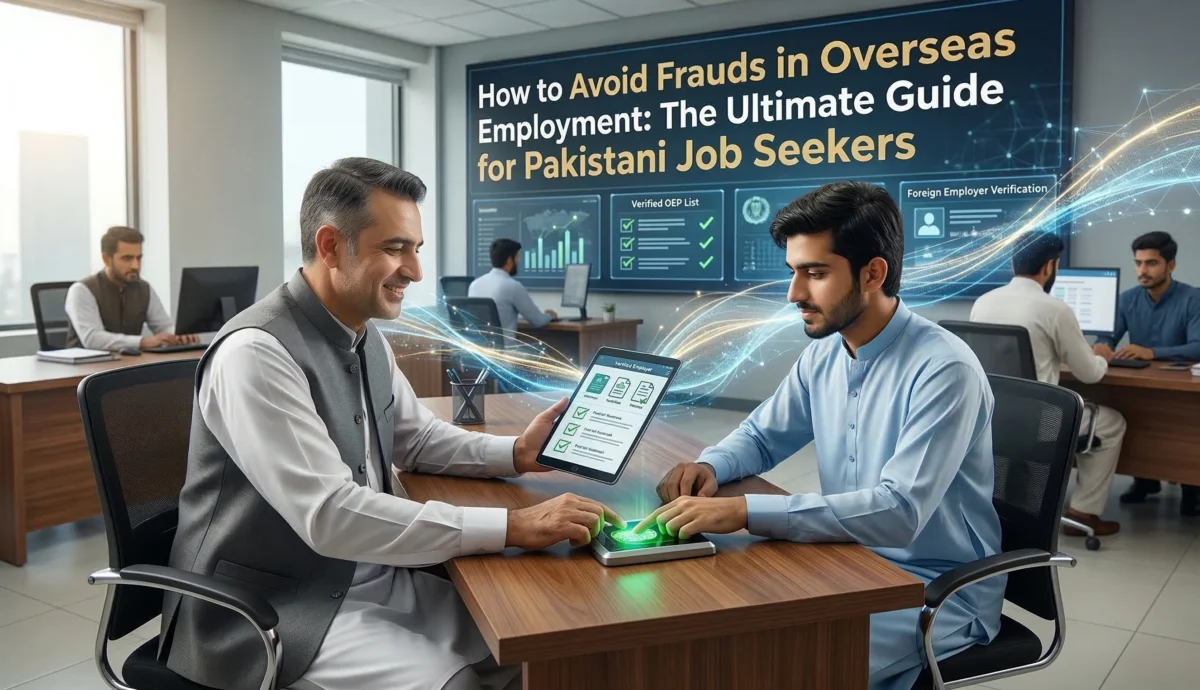
How to Avoid Frauds in Overseas Employment: The Ultimate Guide for Pakistani Job Seekers
The ambition to work abroad is a powerful motivator for thousands of Pakistanis every year. Whether it’s the high-tech industries or the massive infrastructure projects in the Middle East, the prospect of earning a foreign currency and improving one’s standard of living is a noble pursuit. However, this path is often shadowed by “recruiters” who operate in the shadows, using deception to steal hard-earned savings.
To ensure your journey is successful and safe, you must understand that there is only one government-authorized, legitimate, and secure way to find a job abroad: through a licensed Overseas Employment Promoter (OEP) licensed under the Ministry of HRD.
In Pakistan, the Ministry of HRD (Human Resource Development) through BEOE oversees all labor migration. To protect citizens, the Ministry licenses specific entities known as Overseas Employment Promoters.
An OEP is the only legal channel authorized to facilitate your overseas recruitment. Any individual—be they a “sub-agent,” a “freelance consultant,” or a “friend of a friend”—who claims they can get you a visa without an OEP license is operating illegally.
OEP is an Authorized Licensed Recruiting Agency in Pakistan, Not a Agent or Sub Agent.
It is a common and dangerous misconception to refer to an Overseas Employment Promoter (OEP) as an “agent” or “sub-agent.” In the recruitment industry of Pakistan, these terms represent two completely different worlds: one is a state-licensed Recruiting Agency in Pakistan, and the other is an illegal intermediary.
Understanding this distinction is your first line of defense against fraud.
The Legal Identity of an OEP:
An OEP is a professional business entity—often a private limited company or a registered firm—that holds a specific license issued by the BEOE , Ministry of HRD.
- Accountability: Unlike a “sub-agent” who can disappear with a single phone call or just turning mobile switched off, while an OEP has a Government approved physical office, and a security deposit with the government.
- Authorization: The Ministry grants an OEP the legal power to represent foreign employers. When an OEP talks to you, they are acting as the official bridge between the Government of Pakistan and a foreign company.
The Danger of “Sub-Agents” and “Freelance Agents”:
Sub-agents” or “agents” are individuals who operate without any license . They often claim to be “working with” a big OEP, but in reality, they are unregulated middlemen.
-
- No Legal Standing: A sub-agent has no authority to sign a Foreign Service Agreement or to get your passport stamped by the Protector of Emigrants.
- Financial Risk: Because they are not regulated, sub-agents often charge double or triple the government-approved fees and provide no receipts.
- Misinformation: Sub-agents are known to make false promises about salaries and “direct employment” just to get a commission. Once you leave the country and find the job is fake, the sub-agent will deny ever knowing you.
Why the “Direct Contact” Rule Matters?
The BEOE, strictly advises all job seekers to deal directly with the licensed OEP at their registered office.
-
- Zero Middlemen Policy: A legitimate OEP will never send a “freelance agent” to your house to collect money or documents.
- Verified Communication: All official job advertisements in newspapers carry the OEP’s license number , permission no. and official phone numbers. If someone contacts you from a different number claiming to be from that agency, they are likely a fraudulent sub-agent.
The “Recruiting Agency” vs. “Individual Sub-Agents” Difference :
Think of an OEP like a Registered Hospital and an agent like a Street Quack. While both claim to provide a “cure” (a job), only the hospital is staffed by licensed professionals, uses sterilized equipment (verified documents), and is accountable to the health ministry. If something goes wrong with a quack, they vanish; if something goes wrong at a hospital, there is a legal record and a path for justice.
-
- Licensed OEPs must follow a Code of Ethical Conduct under the emigration law of Pakistan.
- Agents/Sub-agents follow no rules and have no fear of government scrutiny and penalties.
The Benefits of Using a Licensed OEP:
- Verification of the Job Demand:
Before an OEP can even post an advertisement in the newspaper, they must obtain a “Permission Number” from the BEOE. This means the government has already:
- Confirmed that the foreign employer actually exists.
- Verified that the number of job vacancies is real.
- Approved the minimum salary to ensure it meets the legal requirements of the host country.
- Legal Power of the Foreign Service Agreement (FSA) :
When you sign a contract through an OEP, you sign a Foreign Service Agreement (FSA). This document is standardized by the BEOE ,Ministry of HRD.
-
- No Hidden Clauses: The standardized agreement ensures absolute transparency, preventing employers from inserting unfair terms or conditions in a foreign language that you cannot understand.
- Enforceability: Since your Foreign Service Agreement (FSA) is a government-verified and registered document, it serves as primary legal evidence. If an employer fails to pay your salary or violates living condition standards, this registered contract enable BEOE to enforce its terms and conditions.
- Government Protection: Your recruitment is registered with the BEOE, meaning the government knows where you are and who you are working for.
- Verified Contracts: OEPs are required to ensure that your employment contract is genuine, signed by the employer, and meets international labor standards.
- Safe Financials: Fees charged by OEPs are regulated. You are protected from the “hidden costs” that often plague the victims of illegal agents.
- Mandatory Pre-Departure Orientation:
Every worker going through an OEP must attend a briefing session at the Protector of Emigrants office. This is a vital learning phase where you receive:
-
- Cultural Guidelines: Advice on the laws and customs of your destination (e.g., Saudi Arabia, UAE, or Europe).
- Emergency Contacts: Details of the nearest Pakistani Consulate and labor attachés.
- Rights Training: Information on how to handle contract disputes or medical emergencies.
Identifying Red Flags: How to Spot a Recruitment Fraud
Fraudsters have become sophisticated, but their tactics usually follow a predictable pattern. By staying alert to these red flags, you can protect yourself:
1. The Demand for Upfront “Processing Fees”
This is the most common scam. If an agent asks for a large sum of money before you have even interviewed with an employer, Selected, Medical Formalities from authorised medical centres, or seen a visa application and visited authorised biometrics centres for biometrics verification , walk away. Legitimate OEPs remain more focus towards the legitimate process initiation and follow a structured payment process regulated by the BEOE .
2.Navigating the Social Media Landscape: Ads, Authenticity, and Vigilance
Social media has become a primary hub for job postings, with platforms like Facebook and LinkedIn flooded with advertisements for “Urgent Staff Needed” in countries like Canada, the UK, or Germany. However, it is a double-edged sword: not every social media advertisement is fake, but certainly, not every advertisement is genuine. While some legitimate OEPs use social media to reach candidates, scammers use the same tools to cast a wide net for victims.
To separate the real opportunities from the traps, candidates must remain highly vigilant and take the following steps:
- Ask for the Permission Number: This is your first line of defense. Every legal job ad must have a Permission Number granted by the (BEOE). If the advertiser hesitates or refuses to provide it, consider it a major red flag.
- Verify Physical Office Premises: Never deal solely through a screen. A legitimate OEP will always have a registered, physical office address. Visit the premises in person to ensure the agency actually exists and is operating professionally.
- Check Online Reviews and Success Stories: Research the agency’s reputation. Look for authentic reviews on Google or social media and seek out “success stories” from real workers who have successfully traveled through them.
- Watch the Communication Channel: While initial contact might happen on social media, genuine international recruitment never concludes via WhatsApp or random Gmail accounts. Official correspondence should come from professional corporate emails.
- The Urgency Trap: Why Speed is a Scammer’s Best Friend :
One of the most powerful psychological weapons used by fraudulent recruiters is the “Urgency Trap.” If an agent or an online advertisement pressures you to make a decision or a payment within hours—claiming that the “quota is filling up” or the “visa will expire”—stop immediately.
- The Reality of Legitimate Recruitment: Genuine overseas recruitment is a structured, legal process that involves multiple steps—Selections, medical exams, police clearances, and Attestations , Protector of Emigrants approvals. No legitimate employer will cancel a genuine job offer because you asked for 24 hours to verify their license. Ethical recruitment respects due process; fraud demands immediate action.
3. The “Direct Employment” Trap
A significant number of overseas job seekers fall victim to the “Direct Employment” illusion. This scam is particularly dangerous because it often involves native living abroad or even foreigners who pose as high-ranking company officials. They contact candidates directly through social media or professional networks, claiming they want to bypass “middlemen” to give the candidate a better deal.
However, this “direct link” is almost always a carefully constructed trap designed to circumvent the legal protections of the regulator.
Scammers will often push candidates to avoid the Protector of Emigrants formality for direct employment. They may claim that “Direct Employment” is a private matter or that the government process is too slow and bureaucratic.
The truth is: The Protector of Emigrants is not a “formality”—it is a legal audit. By pushing you to skip it, the scammer is trying to avoid having their forged documents and exploitative contracts scrutinized by government experts.
When candidates are lured by these direct offers and bypass the official channels, the consequences upon arrival are often devastating:
- Forged Employment Offers: Candidates land in a foreign country only to find that the company named in their “contract” has no record of them, or worse, does not exist at all.
- Unsensible Terms and Conditions: Even if a job exists, the “direct” contract often contains clauses that are illegal or impossible to fulfill—such as working 16 hours a day, having no medical coverage, or receiving a salary that is below the legal minimum of that country.
- No Legal Recourse: Because the contract was never registered with the BEOE, the worker is essentially “invisible” to the Pakistani government, making it nearly impossible or extremely difficult for authorities to intervene or provide legal aid.
The Legal Reality: Direct Employment Still Requires Protection
It is a common myth that direct employment allows you to skip government registration. For a Pakistani citizen, no overseas job is legal until it is registered. Even if you have secured a genuine job offer directly from a foreign employer:
- Mandatory Scrutiny: You are legally required to present your offer letter and visa to the Protector of Emigrants office for “Direct Emigrant” registration.
- Contract Validation: The BEOE will check if the employer is legitimate and if the terms meet the standard requirements for Pakistani workers.
- Insurance & Rights: Only after this process is your life insurance activated and your name entered into the national database of overseas workers.
The Europe Region: A High-Risk Zone for Scams
Currently, there is a massive surge in fraud related to European job offers. Pakistani workers are often targeted with promises of high salaries in countries like Poland, Romania, or Italy.
Why You Must Be Extra Careful with Europe:
Fraudsters often lure candidates with direct employment offers that feature:
- Minimum Wage Traps: They offer the lowest possible legal wage, which is often not enough to survive in Europe after taxes and rent.
- Unclear Payment Terms: Many scammers promise a salary but don’t mention that you’ll have to pay back “travel costs” or “visa expenses” from your first six months of pay.
- Online Fake Ads: New candidates often fall for professional-looking websites that are actually “phishing” sites designed to steal your identity and money.
The Reality: Securing a European work visa is a rigorous process. If an agent tells you it’s “easy” and doesn’t involve a licensed OEP or the BEOE , it is 100% a scam.
How to Verify Your Recruitment Channel
Before you hand over your passport or a single Rupee, follow these steps:
Demand the “Permission Number”:
Every time a foreign company wants to hire from Pakistan, the BEOE, Ministry of HRD issues a specific Permission Number to the OEP. This is the “DNA” of your job offer.
Mandatory Physical Appearance & Biometrics:
Legitimate overseas recruitment is never a “WhatsApp-only” process. Your physical presence is a legal requirement at multiple stages:
- Biometric Verification: Before your visa can even be processed, you must physically visit a designated center (like Etimad / Tasheer Center, Gerry’s/VFS or the Protectorate office) for biometric enrolment (fingerprints OR facial scan).
- Interview Process: Authentic employers or their licensed OEPs conduct structured, in-person, or formal video interviews.
- The “Secretive Agent” Red Flag: If an agent tells you that “everything will be done online” and you don’t need to visit an office or a biometric center, they are likely preparing a fake visa.
Verify Your Visa Authenticity Online :
In 2026, almost every major destination for Pakistani workers (Saudi Arabia, UAE, Qatar, and European nations) has a dedicated online portal to verify visa status.
- Official Links: Most work visas have a Visa Reference Number or E-Number. You should ask for this number and check it yourself , most of them has link given to check and verify .
- The QR Code Test: Most modern visas come with a QR code. Scan it. It should lead to an official
.govwebsite of the destination country, showing your name and passport details.
Mandatory Involvement of the Protector of Emigrants
The most important rule in Pakistani overseas recruitment is that your employment offer must be scrutinized by the Protector of Emigrants (POE). Before you leave the country, your passport must be “Protected.” This is not just a stamp; it is a legal safeguard.
Contract Scrutiny: The Protector of Emigrants officially reviews your Foreign Service Agreement (FSA). They check if the salary, accommodation, and medical facilities promised to you meet the minimum standards set by the POE.
Legal Recognition: Once the POE endorse your employment contract , you are officially recognized by the Government of Pakistan as an “Emigrant.” This entitles you to state protection and assistance through Pakistani embassies abroad.
Insurance Coverage: As part of the “Protector” process, you are automatically enrolled in a comprehensive insurance policy. In case of an accident or death abroad, your family is financially protected.
Prevention of Contract Substitution: By involving the POE, you prevent the common scam where an agent gives you a “good” contract in Pakistan but forces you to sign a “bad” one with lower pay once you arrive in the destination country.
Conclusion
Your future is too valuable to be left in the hands of unlicensed sub agents or anonymous online unverified ads. Overseas employment is a life-changing opportunity, but only when done through the correct, legal, and government-approved channels. By sticking with licensed Overseas Employment Promoters under the BEOE, you ensure that your dream doesn’t turn into a financial tragedy.