
12 Strategies for Construction Manpower Supply Saudi Arabia in Oil, Gas & Healthcare
Construction Manpower Supply Saudi Arabia: A Complete Guide for Employers and Job Seekers
Saudi Arabia, in particular, has emerged as one of the largest construction and development markets globally. With mega projects, oil & gas expansion, and healthcare infrastructure development under Vision 2030, the demand for skilled manpower continues to rise.
For employers, securing reliable and technically competent workers is essential. For job seekers, especially from Pakistan, understanding how manpower supply systems work can open doors to stable overseas employment opportunities.
This article provides a comprehensive overview of construction manpower supply targeting Saudi Arabia and the broader Middle East, focusing on construction, oil & gas, and healthcare sectors — without promotional language, but with practical industry insight.
Saudi Arabia is undergoing historic transformation under Vision 2030. Major projects such as:
- NEOM development
- Saudi Aramco expansion initiatives
- The Red Sea Project
- Qiddiya
have significantly increased workforce requirements.
These developments demand:
- Civil engineers
- Structural supervisors
- Steel fixers
- Masons
- Electricians
- Scaffolders
- Heavy equipment operators
- Safety officers
- Unskilled Labour
Construction manpower supply Saudi Arabia systems must therefore handle high-volume and technically diverse recruitment.
Oil & Gas Sector Manpower Demand
Beyond construction, Saudi Arabia remains a global leader in oil production.
Projects associated with Saudi Aramco and other energy operators require specialized manpower such as:
- Mechanical technicians
- Pipeline welders (6G certified)
- Instrumentation engineers
- Riggers
- QA/QC inspectors
- Shutdown maintenance crews
Oil and gas manpower supply Saudi Arabia requires strict compliance standards, certification checks, and safety training verification.
Because of the technical nature of the sector, trade testing and documentation validation are critical before mobilization.
Healthcare Infrastructure Expansion
Saudi Arabia is also investing heavily in healthcare facilities.
New hospitals, medical cities, and specialty clinics are being developed to improve healthcare services and meet population growth demands.
Healthcare recruitment Saudi Arabia includes:
- Registered nurses
- Lab technicians
- Radiographers
- Biomedical engineers
- Hospital maintenance staff
Unlike construction manpower, healthcare recruitment involves licensing verification, qualification attestation, and regulatory approvals from Saudi health authorities.
Why Pakistani Manpower Remains Significant
Pakistan has historically been one of the largest manpower-exporting countries to the Gulf region.
The reasons include:
- Strong technical training base
- Availability of skilled blue-collar workforce
- English communication capability
- Experience in Middle Eastern work environments
Large-scale construction manpower supply in Pakistan comes from diverse regions including Punjab, KPK, Sindh, ,Balochistan , Azad Kashmir and Gilgit Baltistan.
Workers often possess prior Gulf experience, making them adaptable to Saudi labor standards.
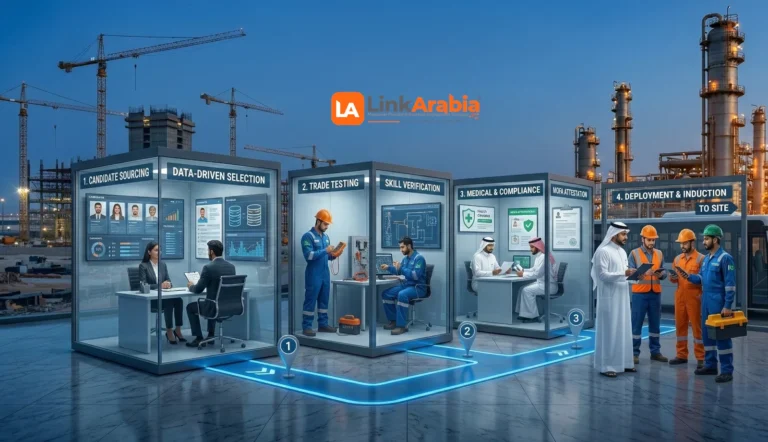
Understanding the Construction Manpower Supply Process
1. Workforce Demand Identification
Employers define:
- Number of workers required
- Skill level
- Contract duration
- Project location
- Salary package
This determines sourcing strategy.
2. Candidate Sourcing Across Regions
Manpower supply systems in Pakistan involve:
- Licensed Recruitment Agency
- Regional trade centres
- Technical institutes
- Referral networks
- Skill-specific databases
3. Trade Testing and Skill Verification (Takamol Testing)
Construction manpower supply Saudi Arabia requires practical skill assessment.
Common trade tests include:
- Construction Labour Takamol Test
- Welding Takamol Test
- Electrical wiring boards
- Masonry sample structures
- Equipment operation skills Takamol testing.
Skill validation reduces employer risk and project delays.
4. Documentation
Mobilization to Saudi Arabia involves:
- Passport verification
- Police clearance
- Medical examination and Vaccinations
- Takamol Skills Testings
- Employment Contract signing
- MOFA attestation (if any required)
- Visa stamping
- Employment Protector
Compliance with Saudi labor regulations is mandatory.
Official references regarding Saudi labor systems can be found at:
These resources outline employment regulations and attestation procedures.
Challenges in Construction Manpower Supply Middle East
Despite strong systems, challenges remain.
Workforce Shortages During Mega Projects
Simultaneous projects create high demand, causing temporary labor shortages.
Changing Saudization Policies
Saudi Arabia encourages employment of nationals in certain sectors. Construction and oil & gas still rely on expatriate labor, but policies must be monitored carefully.
Certification Authenticity
Verification of experience certificates and trade licenses is crucial.
Oil & Gas Workforce Compliance Standards
Oil and gas manpower supply Saudi Arabia follows stricter compliance compared to general construction.
Requirements often include:
- Aramco- or SABIC approved certifications
- Safety training (NEBOSH & OSHA equivalent)
- H2S awareness certification
- Project-specific induction
Failure to meet compliance standards can result in worker rejection at site entry points.
Healthcare Staffing Regulations
Healthcare professionals must:
- Verify academic degrees
- Pass Saudi licensing examinations
- Obtain classification through regulatory bodies
This process ensures patient safety and quality standards.
Job Seekers’ Perspective
For workers, overseas employment in Saudi Arabia offers:
- higher salary returns
- Tax-free income
- Accommodation and Transportation benefits
- Medical Insurance coverage
- Contract-based security
However, job seekers should:
- Verify recruitment channels
- Avoid unofficial intermediaries
- Ensure proper documentation
- Understand contract terms clearly
The Role of Vision 2030 in Workforce Demand
Saudi Vision 2030 has transformed workforce planning.
Projects like NEOM and Qiddiya require multi-disciplinary manpower including:
- Construction engineers
- Construction MEP manpower
- Construction Labour
- Environmental specialists
- Urban planners
- Healthcare facility managers
Construction manpower supply Saudi Arabia must adapt to this diversified demand.
Future Outlook for Construction Manpower Supply Saudi Arabia
The future indicates:
- Continued infrastructure investment
- Expansion in renewable energy projects
- Growth in hospital and medical cities
- Increased industrial diversification
Oil & gas will remain significant, but non-oil sectors are rapidly expanding.
This sustained growth ensures consistent demand for skilled overseas manpower.
Strategic Importance of Organized Manpower Supply Systems
Structured manpower supply by the licensed recruitment agency in Pakistan ensures:
- Reduced project downtime
- Skill matching accuracy
- Legal compliance
- Smooth mobilization
- Lower recruitment risk
For both employers and job seekers, transparent and compliant systems are essential.
Construction manpower supply Saudi Arabia is not merely about sending workers abroad. It is about building sustainable workforce partnerships that support economic growth in both sending and receiving countries.
Conclusion
Construction manpower supply Saudi Arabia remains a cornerstone of Middle Eastern industrial and infrastructure development.
With expansion across construction, oil & gas, and healthcare sectors, the need for organized overseas manpower recruitment systems continues to grow.
Employers require reliable, technically skilled workers who meet compliance standards. Job seekers seek transparent processes and stable overseas employment opportunities.
A structured approach — involving sourcing across Pakistan’s regions, trade testing, documentation compliance, and regulatory adherence — ensures success for both sides.
As Saudi Arabia continues its transformation under Vision 2030, workforce mobility between Pakistan and the Kingdom will remain strategically significant in shaping the region’s future.