

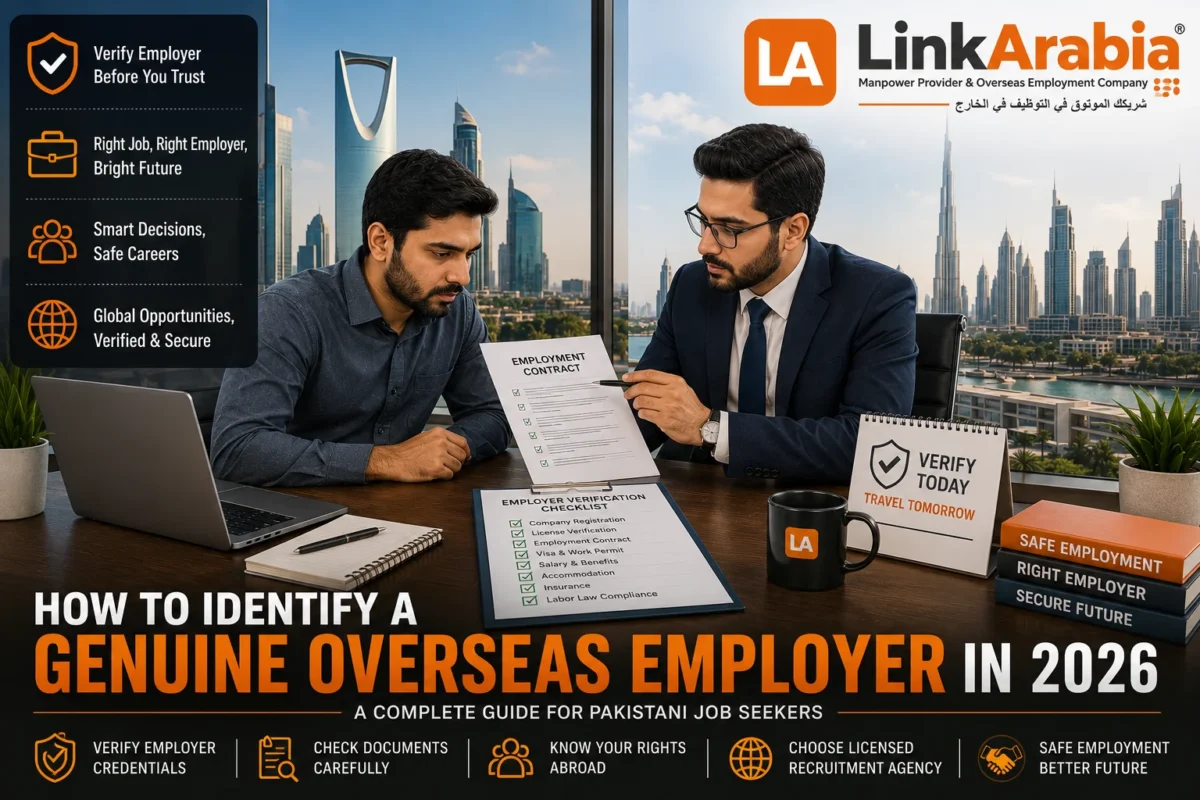
How to Identify a Genuine Overseas Employer in 2026: A Complete Guide to Making Safe Overseas Employment Decisions
How to identify genuine overseas employer is one of the most important questions every Pakistani job seeker should answer before accepting an overseas job offer. Choosing the right employer can determine whether your overseas career becomes a success or a costly mistake.Every year, thousands of Pakistani professionals, technicians, skilled workers, and laborers pursue overseas employment to secure better salaries, career growth, and improved living standards. Countries across the Gulf Cooperation Council (GCC), Europe, East Asia, and other regions continue to rely on foreign talent to support their economies. However, alongside genuine opportunities, fraudulent job offers, misleading advertisements, fake employment contracts, and unethical recruitment practices remain significant concerns.
One of the most important decisions a job seeker can make is choosing the right employer. A high salary alone does not guarantee a good employment experience. Factors such as salary payment history, compliance with labor laws, employee welfare, workplace safety, accommodation standards, contract transparency, and the employer’s overall business reputation often determine whether an overseas career becomes a success or a costly mistake.
In 2026, identifying the reputation of an overseas employer requires more than reading online reviews or trusting social media advertisements. Job seekers should conduct structured due diligence using official government sources, employment regulations, company records, and professional recruitment channels before accepting any offer.
This guide explains how to evaluate overseas employers using a practical, evidence-based approach. It also highlights why working through a licensed overseas recruitment agency in Pakistan generally provides additional safeguards compared with relying on unverified brokers or informal intermediaries.
Quick Answer
How to Identify Genuine Overseas Employer Before Accepting Any Job in 2026?
The safest approach is to verify the employer through official government records, confirm business registration, review employment contracts carefully, check labor law compliance, validate visa sponsorship, research payment history, seek independent employee feedback, and, whenever possible, apply through a licensed overseas recruitment agency operating under the regulatory framework of Pakistan’s Ministry of Overseas Pakistanis and Human Resource Development (MOPHRD).
Never rely solely on salary offers, social media advertisements, or verbal promises.
Why Employer Reputation Matters More Than Salary ?
Many job seekers focus first on the salary package. While income is important, experienced recruiters know that salary is only one part of the overall employment experience.
A reputable employer usually demonstrates consistency in several areas:
- Pays salaries on time.
- Provides legally compliant employment contracts.
- Respects local labor regulations.
- Maintains safe working conditions.
- Supports employees with work permits and visa renewals.
- Offers appropriate accommodation when promised.
- Maintains transparent communication.
By contrast, employers with poor reputations often display warning signs long before problems arise. Delayed salary payments, constantly changing employment terms, lack of written documentation, excessive overtime without compensation, and poor communication frequently indicate deeper organizational issues.
A worker who accepts a seemingly attractive salary from an unreliable employer may ultimately lose far more through unpaid wages, unexpected contract changes, or legal complications.
What Defines a Reputable Overseas Employer?
A reputable overseas employer is not simply a company with a well-known name. Reputation is built through consistent legal compliance, ethical employment practices, financial stability, and positive treatment of employees.
Characteristics of a reputable employer
| Evaluation Area | Positive Indicators |
|---|---|
| Legal Status | Properly registered business |
| Recruitment | Transparent hiring process |
| Employment Contract | Clear written terms |
| Salary | Defined payment schedule |
| Visa Sponsorship | Correct work visa |
| Employee Welfare | Insurance and benefits where applicable |
| Communication | Professional and responsive |
| Compliance | Follows local labor regulations |
Think of employer reputation as a puzzle. No single factor proves trustworthiness. Instead, multiple pieces of evidence should point toward reliability before making a decision.
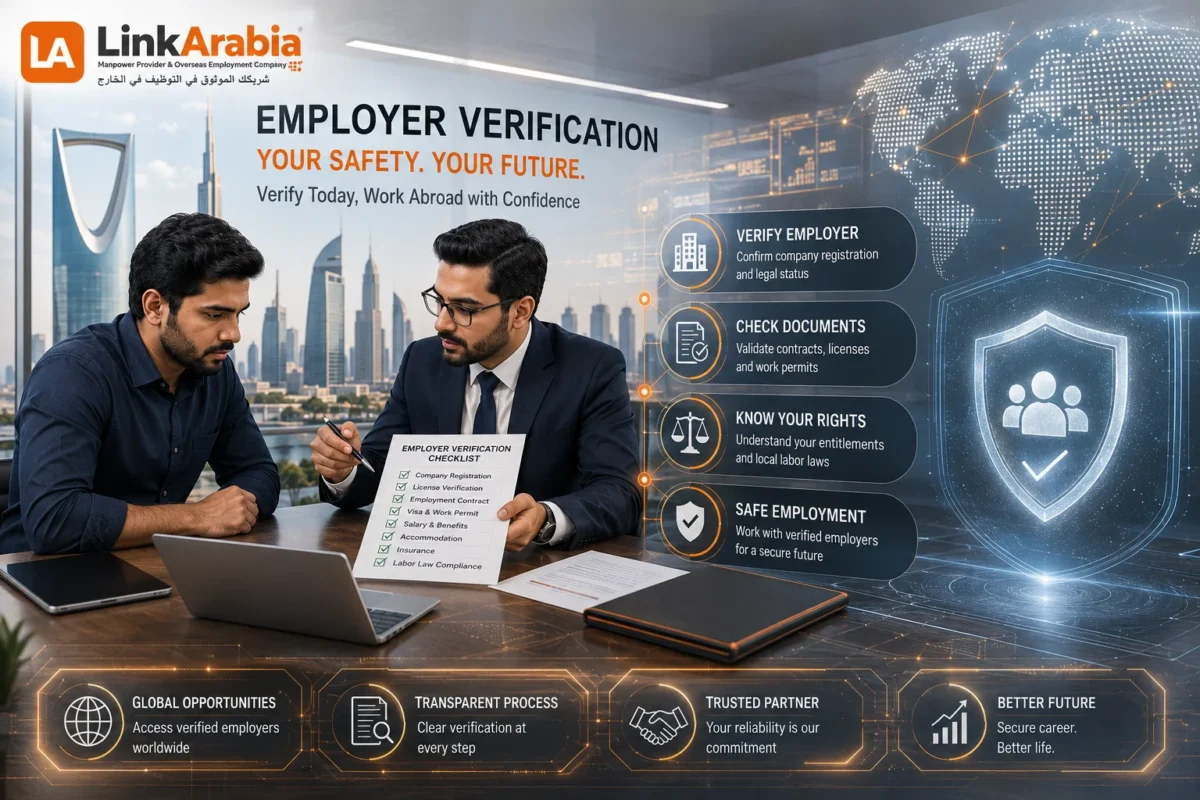
Step 1: Verify the Employer's Legal Registration
Your first task is confirming that the company legally exists.
Most countries maintain official business registration databases through ministries, commerce departments, or company registrars.
Examples include:
- Company registrars
- Chamber of Commerce memberships
- Government business licensing portals
Avoid relying only on:
- Facebook pages
- WhatsApp profiles
- Instagram advertisements
- PDF brochures
- Visiting cards
These items are easy to create and do not prove legal existence.
Expert Insight
Fraudulent recruiters often invest heavily in attractive marketing materials because these are inexpensive compared with maintaining a legitimate business.
Step 2: Confirm the Employer Actually Hires Foreign Workers
Not every registered company has permission to employ foreign nationals.
Before accepting an offer, determine whether the employer:
- Sponsors foreign workers.
- Holds necessary labor approvals.
- Has previously employed international staff.
- Complies with immigration regulations.
In many destination countries, employers must obtain approvals before recruiting workers from abroad.
An employer unable to explain its recruitment process or visa sponsorship should be treated cautiously.
Step 3: Examine the Employment Contract Carefully
A genuine employer provides a written employment contract before deployment.
Never rely on verbal promises.
The contract should clearly specify:
- Job title
- Monthly salary
- Working hours
- Overtime policy
- Leave entitlement
- Accommodation arrangements
- Transportation
- Medical insurance
- Contract duration
- Termination conditions
Red Flag
If the employer says:
“Don’t worry—we’ll discuss everything after you arrive.”
You should pause immediately.
A professional employer has no reason to hide employment conditions.
Step 4: Research the Employer's Reputation Beyond Online Reviews
Online reviews can provide useful clues, but they should never be your only source.
Some reviews are genuine.
Others may be:
- Fake.
- Paid promotions.
- Written by competitors.
- Outdated.
- Based on isolated experiences.
Instead, compare information from multiple independent sources.
Better sources include:
- Official company announcements
- Government enforcement notices
- Company Linkedin Accounts
- Industry associations
- Professional networking platforms
- Current and former employees
Consistency across several reliable sources is much more valuable than one highly positive or highly negative review.
Step 5: Evaluate Communication Quality
Professional employers communicate professionally.
During recruitment, observe whether they:
- Respond consistently.
- Use official company email addresses. this is one of the key element . always ask for official correspondence from official email address , which must match existing official website of the company.
- Provide written documentation.
- Explain recruitment procedures.
- Answer reasonable questions.
Poor communication during recruitment often becomes worse after deployment.
The Importance of Using a Licensed Recruitment Agency in Pakistan
One of the safest ways to reduce recruitment risks is to apply through a licensed overseas employment promoter operating under Pakistan’s regulatory framework.
Licensed recruitment agencies operate under the licensing system administered by the Ministry of Overseas Pakistanis and Human Resource Development (MOPHRD) (BEOE). Their recruitment activities are subject to government regulations, and they are expected to comply with applicable legal requirements governing overseas recruitment.
Why this matters
A licensed recruitment agency typically goes through verification process from the Government Regulatory departments before processing candidates. This may include reviewing overseas employer demand documents, visa-related paperwork, employment terms, and other required approvals under applicable regulations.
More importantly, workers have an identifiable licensed organization in Pakistan that can assist throughout the recruitment process.
Licensed Recruitment Agency vs Informal Agent
Licensed Overseas Recruitment Agency | Informal Broker |
| Operates under a government licensing framework | No formal regulatory oversight |
| Subject to applicable recruitment regulations | Often operates without accountability |
| Uses documented recruitment procedures | Frequently relies on verbal commitments |
| Can be contacted locally during recruitment | May become unreachable after payment |
| Complaint mechanisms may be available through relevant authorities | Limited practical recourse |
This additional level of oversight makes licensed recruitment agencies the preferred option for many job seekers seeking overseas employment.
Expert Observation
Experienced recruiters know that many overseas employment disputes begin long before the worker boards the aircraft.
Most problems originate during recruitment through:
- Fake employers
- Unverified intermediaries
- Altered contracts
- Incorrect visa categories
- Misleading salary promises
Proper verification before departure is significantly easier than attempting to resolve disputes after arriving in another country.
Common Red Flags in Overseas Employment That Should Never Be Ignored
If you encounter several of the following warning signs, reconsider the opportunity carefully.
Major warning signs
- Salary changes repeatedly.
- No written employment contract.
- Pressure to make immediate payment.
- Communication only through personal messaging apps.
- Requests to travel on an inappropriate visa.
- Refusal to answer basic employment questions.
- Recruitment through unofficial social media accounts only.
The presence of one warning sign does not always prove fraud.
However, multiple warning signs together should prompt additional verification before proceeding.
Step 6: Verify the Work Visa and Immigration Process
A legitimate overseas employer will always explain how you will legally enter and work in the destination country. Before accepting any offer, ask which visa category you will receive and who is responsible for obtaining it.
A genuine employer or licensed recruitment agency should be able to provide clear information about:
- Work visa category
- Sponsorship process
- Estimated processing time
- Medical examination requirements
- Employment contract approval (where applicable)
- Arrival procedures
Never agree to travel on a visit visa, tourist visa, business visa, or any visa that does not legally authorize employment unless the destination country’s laws explicitly permit a legal status change through official procedures.
Expert Insight
Many overseas employment disputes begin because workers unknowingly travel on the wrong visa. Even if the employer promises to “change it later,” the worker may face legal penalties, deportation, or loss of employment. Always verify the visa category before departure.
Step 7: Understand Local Labour Laws
Before accepting employment, spend time understanding the labour regulations of your destination country.
Although employment laws vary, workers should generally know:
- Maximum working hours
- Weekly rest days
- Annual leave entitlement
- Overtime regulations
- Medical insurance obligations
- End-of-service benefits (where applicable)
- Procedures for changing employers
- Employment dispute mechanisms
Understanding these rights allows workers to identify unusual contract clauses before signing.
Knowledge is one of the strongest forms of protection.
Step 8: Verify Salary, Benefits and Hidden Costs
A salary offer should always be evaluated together with the complete employment package.
Ask questions such as:
- Is accommodation provided?
- Is transportation included?
- Who pays for medical insurance?
- Are annual air tickets included?
- Is overtime paid separately?
- Are meals provided?
- Are uniforms supplied?
Sometimes a seemingly lower salary results in greater savings because essential expenses are covered by the employer.
Likewise, an attractive salary may lose much of its value if workers must pay for accommodation, transportation, insurance, and meals themselves.
Why Licensed Recruitment Agencies Provide Additional Confidence
Why Choosing a Licensed Recruitment Agency in Pakistan Is Often the Safer Option
Many job seekers ask whether they should apply directly to an overseas employer or use a licensed recruitment agency. they differ significantly in terms of verification, regulatory oversight, and the level of protection available to workers.
Option 1: Direct Employment (Individual Employment Offers)
In some cases, particularly for non-traditional destination countries, overseas employers may recruit Pakistani workers directly without involving a licensed recruitment agency. These are commonly known as Direct Employment or Individual Employment Offers.
Under this arrangement, the employer issues an employment offer directly to the worker, who is responsible for completing the required documentation and obtaining approval before departing Pakistan.
To safeguard workers, the Ministry of Overseas Pakistanis and Human Resource Development (MOPHRD) (BEOE) verifies eligible direct employment offers and supporting documents during the overseas employment registration process. Before a worker can receive an Employment Protector, the relevant employment documents, visa, employment contract, and other required paperwork are scrutinized in accordance with applicable regulations.
This government verification provides an important layer of protection. However, direct employment still carries a comparatively higher level of risk because the worker is primarily responsible for assessing the employer’s credibility before accepting the offer. Unless the employer is already well known or independently verified, applicants may have limited information about the company’s recruitment history, financial standing, treatment of foreign workers, or compliance with local labour laws.
For this reason, job seekers should exercise additional caution when accepting direct employment offers from unfamiliar overseas employers.
Option 2: Recruitment Through a Licensed Overseas Recruitment Agency
For many job seekers—particularly first-time overseas workers—the safer and more structured option is to apply through a licensed Overseas Employment Promoter (Licensed Recruitment Agency) in Pakistan.
Licensed recruitment agencies operate under the regulatory framework of the Ministry of Overseas Pakistanis and Human Resource Development (MOPHRD) (BEOE) and are subject to government oversight. Their overseas recruitment activities must comply with applicable laws, regulations, and licensing requirements.
Before presenting overseas opportunities to Pakistani candidates, BEOE and licensed agencies generally conduct extensive due diligence on the employer and the recruitment process. Depending on the destination country and recruitment model, this may include verifying:
- Employer registration and legal status.
- Business legitimacy and operational history.
- Verification of Recruitment demand and manpower requirements.
- Employment contracts and offered terms.
- Visa and immigration documentation.
- Salary, benefits, and working conditions.
- Required government approvals and supporting documentation.
- Potential recruitment red flags that could expose workers to unnecessary risks.
This additional layer of professional verification significantly reduces the likelihood of workers becoming victims of fake job offers, forged documents, unauthorized recruiters, or misleading employment conditions.
Another important advantage is that workers have a licensed and accountable organization within Pakistan that can provide guidance before departure and assist in resolving recruitment-related concerns when appropriate.
Employment Protector – A Mandatory Safeguard for All Overseas Workers
Regardless of whether a worker secures employment directly from an overseas employer or through a licensed recruitment agency, obtaining an Employment Protector is a mandatory legal requirement before departing Pakistan for overseas employment.
During the Employment Protector process, the relevant authorities examine the employment-related documents, which may include:
- Employment offer letter.
- Employment contract.
- Work visa.
- Passport and identity documents.
- Employer information.
- Other supporting documents required under applicable regulations.
- Verification of Manpower Demand and list goes on.
Only after completing the prescribed verification process can an overseas worker obtain the necessary clearance for lawful overseas employment.
This mandatory process serves as an important safeguard intended to reduce document fraud, protect migrant workers, and promote compliance with Pakistan’s overseas employment regulations.
Common Mistakes Job Seekers Make
Even experienced professionals occasionally overlook critical verification steps.
The most common mistakes include:
- Accepting offers based only on salary.
- Trusting social media advertisements without verification.
- Signing contracts without reading every clause.
- Paying money without obtaining official receipts.
- Ignoring visa details.
- Believing verbal promises.
- Failing to research the employer’s history.
- Using unauthorized intermediaries instead of licensed recruitment agencies.
- Not asking about accommodation and insurance.
- Rushing decisions due to fear of losing the opportunity.
Avoiding these mistakes greatly improves the chances of a successful overseas career.
Conclusion
Finding overseas employment in 2026 requires more than enthusiasm and technical skills. It requires informed decision-making.
The reputation of an overseas employer should never be judged solely by salary offers or attractive advertisements. Instead, evaluate the employer through legal registration, contract transparency, labour law compliance, visa sponsorship, financial stability, employee welfare, and professional communication.
For Pakistani job seekers, working with a licensed overseas recruitment agency provides valuable safeguards because these agencies operate within the regulatory framework administered by the Ministry of Overseas Pakistanis and Human Resource Development (MOPHRD) (BEOE). Government oversight, documented recruitment procedures, and local accountability make licensed agencies an important component of safer international recruitment.
However, the safest approach combines professional guidance with personal responsibility. Every worker should independently review the employment contract, verify the employer’s credentials, understand the visa process, and learn about the labour laws of the destination country before making a final decision.
Overseas employment can be life-changing when built on careful planning, accurate information, and responsible recruitment practices. Taking time to verify an employer today can prevent financial losses, legal complications, and unnecessary hardship tomorrow.
⚠️ DISCLAIMER

The information provided in this article is intended for general informational purposes only. It does not constitute professional legal, financial, or career advice. While every effort has been made to ensure the accuracy of the information presented, the employment landscape, government regulations, and overseas labour market conditions are subject to change.

Readers are strongly encouraged to conduct their own independent research, consult with qualified professionals, and verify the credentials and licensing of any recruitment agency before engaging their services.

Always check with relevant government authorities, including the Ministry of Overseas Pakistanis and Human Resources Development (MOPHRD), for the most current regulations and approved agency listings.

linkarabiapk.com does not endorse, represent, or take responsibility for any specific recruitment agency or third-party service mentioned or implied in this content.