
Active Job Seekers vs Passive Job Seekers: 15 Powerful Gulf Hiring Insights
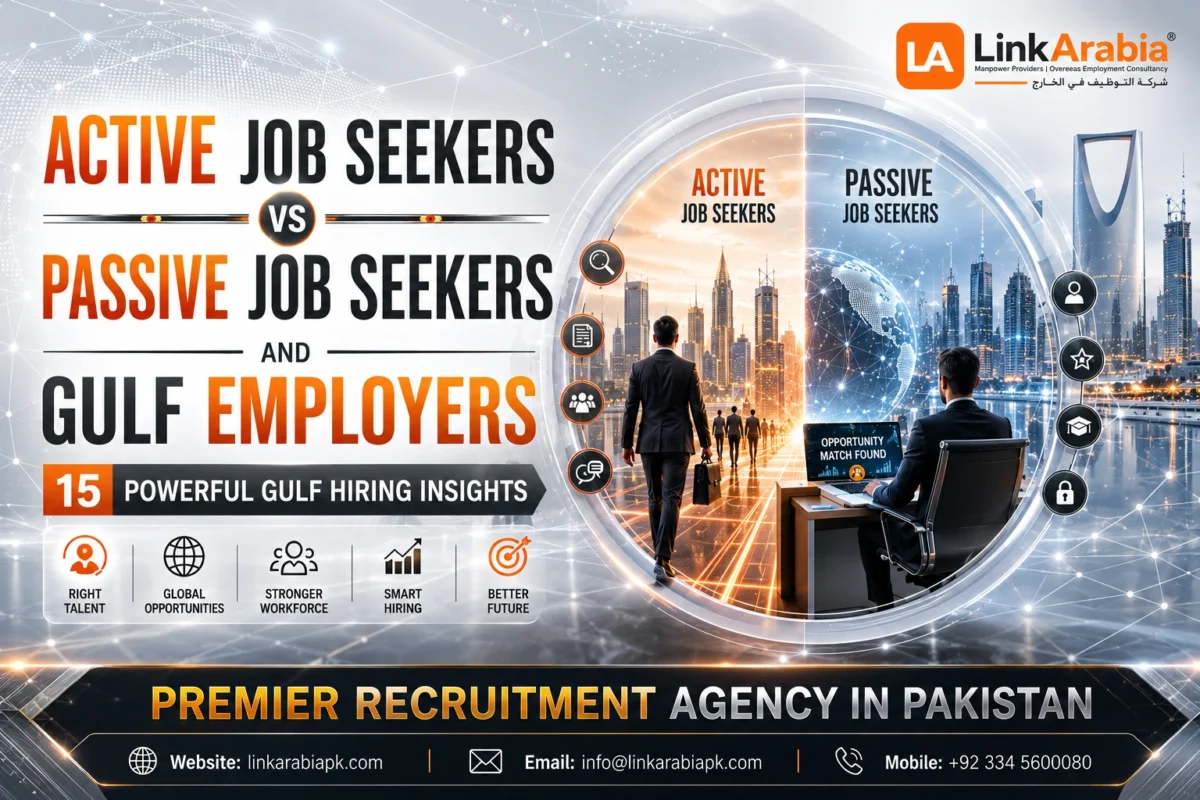
Active Job Seekers vs Passive Job Seekers has become one of the most important discussions in modern recruitment, particularly across Gulf Cooperation Council (GCC) countries including Saudi Arabia, the United Arab Emirates, Qatar, Kuwait, Bahrain, and Oman.
As Gulf economies continue to diversify through national transformation initiatives, infrastructure development, digital transformation, tourism expansion, healthcare growth, logistics investments, and industrial development, employers face increasing pressure to attract highly skilled talent.
However, not all candidates search for jobs in the same way.
Some individuals actively apply for vacancies every day, while others are already employed, performing well in their current roles, and are not actively seeking new opportunities. Yet many of these professionals may still consider a move if presented with the right career opportunity.
This distinction creates two important talent categories:
- Active Job Seekers
- Passive Job Seekers
Understanding these groups is essential for Gulf employers, recruiters, hiring managers, HR professionals, and job seekers themselves.
In today’s competitive labor market, successful employers rarely rely on a single sourcing strategy. Instead, they build recruitment systems capable of attracting both active and passive talent pools. Research from professional recruiting organizations consistently indicates that a significant portion of the workforce is not actively job searching but may be open to discussing attractive opportunities.
This article explains the differences between active and passive job seekers, explores how Gulf employers approach recruitment, and provides practical insights for organizations seeking top talent.
What Is an Active Job Seeker?
An active job seeker is a person who is currently searching for employment opportunities and actively participating in the hiring market.
Characteristics of Active Job Seekers
Active candidates typically:
- Apply for jobs regularly
- Update their resumes frequently
- Search online job portals
- Attend career fairs
- Respond quickly to recruiter outreach
- Participate in interviews actively
- Network with employers and recruiters
These candidates may be:
- Unemployed
- Recently graduated
- Seeking career advancement
- Looking for better compensation
- Relocating to another country
- Dissatisfied with their current employer
According to recruitment industry research, active candidates represent a smaller portion of the overall workforce compared to professionals who are employed and not actively searching.
Advantages of Hiring Active Job Seekers
For Gulf employers, active candidates offer several benefits:
Faster Hiring Process
Active candidates usually move through recruitment stages quickly because they are already seeking employment.
Greater Availability
They are often available for interviews, assessments, and onboarding within shorter timelines.
Larger Applicant Pool
Job advertisements can generate substantial interest from active candidates.
Easier Communication
Active applicants typically respond more rapidly to recruiter communications.
Challenges of Hiring Active Job Seekers
While active candidates are important, employers may encounter challenges such as:
High Competition
Top active candidates may receive multiple offers simultaneously.
Increased Application Volumes
Recruiters often receive large numbers of applications requiring screening.
Variable Candidate Quality
Not every applicant possesses the qualifications required for specialized roles.
Job Search Fatigue
Candidates who have applied extensively may experience frustration or reduced engagement.
What Is a Passive Job Seeker?
A passive job seeker is an individual who is employed and not actively searching for a new position but may consider changing jobs if presented with an attractive opportunity.
Passive candidates often:
- Perform well in current roles
- Are not applying to job advertisements
- Are not browsing job boards regularly
- Focus on career growth rather than job searching
- Remain open to strategic opportunities
Recruitment research consistently identifies passive talent as a major segment of the workforce.
Characteristics of Passive Job Seekers
Passive candidates commonly:
- Have stable employment
- Possess specialized expertise
- Maintain strong professional reputations
- Receive recruiter approaches regularly
- Evaluate opportunities carefully
- Prioritize long-term career development
Why Gulf Employers Are Increasingly Interested in Passive Candidates
Across Saudi Arabia, UAE, Qatar, Kuwait, Bahrain, and Oman, many employers compete for specialized talent.
Examples include:
- Engineers
- Healthcare professionals
- IT specialists
- Data analysts
- Cybersecurity experts
- Project managers
- Construction supervisors
- Energy sector professionals
- Hospitality managers
When demand exceeds supply, employers frequently engage passive talent directly.
Benefits of Passive Candidates
Proven Experience
Passive candidates often possess established track records.
Reduced Competition
Because they are not actively applying elsewhere, employers may face fewer competing offers.
Specialized Skills
Many passive professionals hold niche expertise developed through years of industry experience.
Leadership Potential
Senior professionals frequently fall within the passive candidate category.
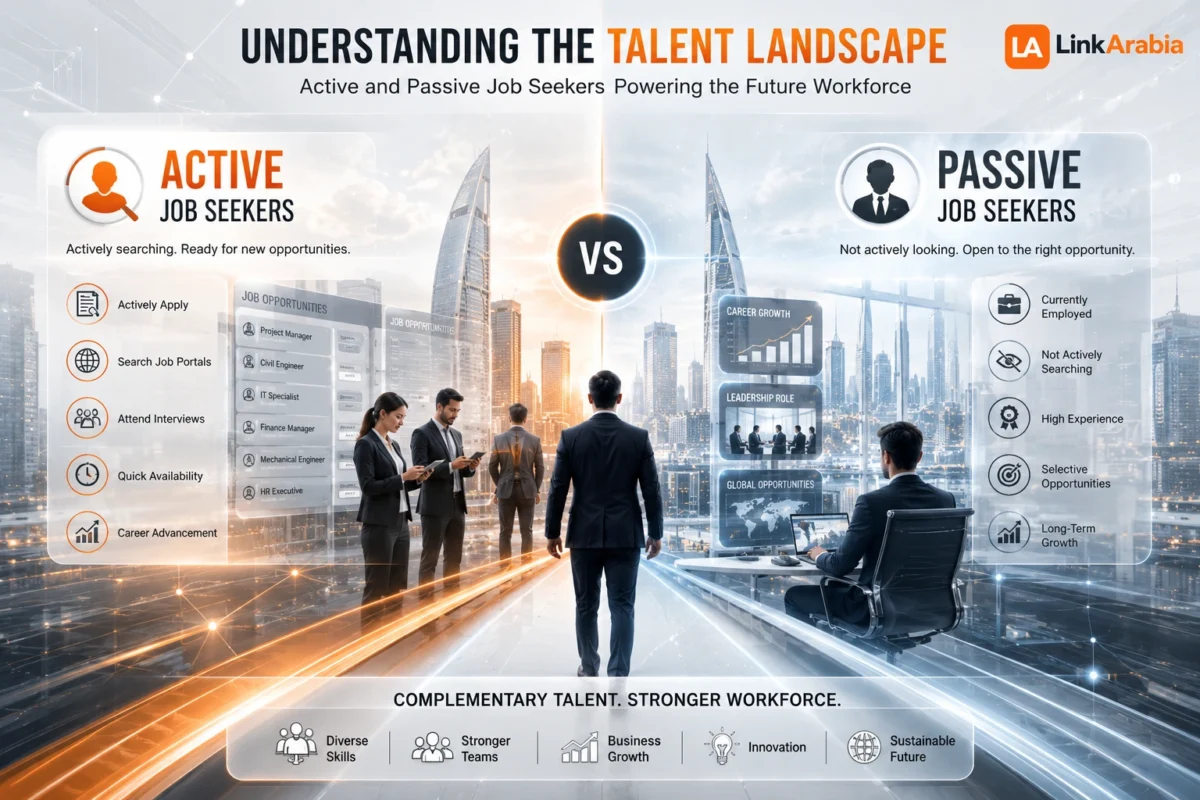
Active Job Seekers vs Passive Job Seekers: Key Differences
| Factor | Active Job Seekers | Passive Job Seekers |
|---|---|---|
| Job Search Activity | Actively searching | Not actively searching |
| Applications | Frequent | Rare |
| Availability | Immediate | Selective |
| Recruiter Response | Usually fast | Often slower |
| Competition | High | Lower |
| Hiring Timeline | Faster | Longer |
| Employer Outreach Needed | Low | High |
| Career Stability | Varies | Usually stable |
| Skill Availability | Mixed | Often specialized |
| Recruitment Cost | Lower | Potentially higher |
How Gulf Employers Recruit Active Job Seekers
1. Job Portals
Organizations advertise vacancies through career platforms and corporate websites.
2. Career Fairs
Universities and professional events remain important recruitment channels.
3. Recruitment Campaigns
Large employers regularly conduct hiring drives for:
- Construction projects
- Healthcare facilities
- Manufacturing plants
- Hospitality operations
- Logistics hubs
4. Employee Referrals
Referral programs often generate qualified active candidates.
5. Licensed Recruitment Agencies in Pakistan
Many Gulf employers recruit active job seekers through licensed overseas employment promoters in Pakistan that are regulated by the Ministry of Overseas Pakistanis and Human Resource Development (MOPHRD). These agencies maintain databases of actively available candidates, conduct screening and interviews, verify documents, and facilitate compliant recruitment processes for employers seeking immediate workforce deployment.
How Gulf Employers Recruit Passive Job Seekers
Recruiting passive candidates requires a different approach.
1. Professional Networking
Recruiters actively build relationships with professionals across industries.
2. Talent Communities
Many organizations create talent communities and future candidate pipelines.
3. Social Media Recruiting
Professional networks help recruiters identify skilled professionals.
4. Direct Sourcing
Recruiters conduct targeted outreach to professionals who match role requirements.
5. Employer Branding
Strong employer brands attract passive candidates over time.
6. Strategic Talent Acquisition Through Licensed Recruitment Agencies in Pakistan
Many Gulf employers partner with licensed recruitment agencies in Pakistan to access passive job seekers who are not actively applying for jobs but possess valuable industry experience and specialized skills. Established recruitment agencies maintain extensive talent databases built through years of candidate engagement, industry networking, previous placements, skills testing programs, and professional relationships. This allows Gulf employers to identify and approach qualified professionals discreetly without investing significant time and resources in direct talent sourcing. For employers, this approach provides access to a broader talent pool, including experienced candidates who may not be visible on job portals, resulting in higher-quality shortlists, reduced recruitment risks, faster hiring decisions, and improved workforce quality for critical and hard-to-fill positions.
Why Employer Branding Matters in the Gulf
Employer branding has become a critical recruitment tool.
Candidates increasingly evaluate:
- Company reputation
- Career growth opportunities
- Leadership quality
- Workplace culture
- Training programs
- Diversity initiatives
- Compensation competitiveness
A strong employer brand can attract both active and passive candidates.
Industries Where Passive Candidates Are Highly Valuable
Oil and Gas
Specialized technical expertise remains in high demand.
Construction and Infrastructure
Mega-projects across the GCC require experienced professionals.
Information Technology
Digital transformation increases demand for specialized talent.
Healthcare
Qualified medical professionals are often approached directly.
Aviation
Airlines and airport operators seek experienced specialists.
Manufacturing
Industrial growth requires skilled technical leadership.
Conclusion
The debate surrounding Active Job Seekers vs Passive Job Seekers is not about determining which group is better. Rather, it is about understanding how each group contributes to successful workforce planning.
Key takeaways include:
- Active job seekers provide immediate hiring opportunities.
- Passive job seekers offer access to highly experienced professionals.
- Gulf employers increasingly combine active recruitment and passive sourcing strategies.
- Employer branding plays a crucial role in attracting quality talent.
- Technology, ATS platforms, AI tools, and talent communities are transforming recruitment.
- Long-term talent pipelines improve hiring efficiency.
- Both employers and job seekers benefit from strategic relationship-building.
As Gulf economies continue to expand and diversify, organizations that successfully engage both active and passive talent pools will be better positioned to meet workforce demands and achieve sustainable growth.
Frequently Asked Questions (FAQs) Maktab Al Amal
1. What is the difference between active and passive job seekers?
Active job seekers are currently searching and applying for jobs, while passive job seekers are employed and not actively looking but may consider suitable opportunities.
2. Why do Gulf employers recruit passive candidates?
Passive candidates often possess specialized skills, proven experience, and stable employment histories.
3. Are passive candidates better than active candidates?
Not necessarily. Both groups offer unique advantages depending on the role and hiring objectives.
4. Which industries recruit passive candidates most frequently?
Oil and gas, healthcare, technology, construction, aviation, and manufacturing commonly target passive talent.
5. How do recruiters find passive candidates?
Through networking, professional platforms, employee referrals, talent communities, and direct sourcing.
6. Can passive candidates become active job seekers?
Yes. Career goals, organizational changes, compensation concerns, or personal circumstances can influence job-search behavior.
7. What is a talent pipeline?
A talent pipeline is a pool of potential candidates maintained for future hiring needs.
8. Why is employer branding important?
Employer branding helps organizations attract, engage, and retain qualified professionals.
9. Do Gulf employers use ATS systems?
Many organizations use ATS platforms to manage applications and recruitment processes.
10. What should job seekers do to improve visibility?
Maintain updated resumes, strengthen professional profiles, network actively, and continue developing skills.
⚠️ DISCLAIMER

The information provided in this article is intended for general informational purposes only. It does not constitute professional legal, financial, or career advice. While every effort has been made to ensure the accuracy of the information presented, the employment landscape, government regulations, and overseas labour market conditions are subject to change.

Readers are strongly encouraged to conduct their own independent research, consult with qualified professionals, and verify the credentials and licensing of any recruitment agency before engaging their services.

Always check with relevant government authorities, including the Ministry of Overseas Pakistanis and Human Resources Development (MOPHRD), for the most current regulations and approved agency listings.

linkarabiapk.com does not endorse, represent, or take responsibility for any specific recruitment agency or third-party service mentioned or implied in this content.