
Riyadh Metro Station Expansion Project: 5 Powerful Wins Reshaping Saudi Arabia in 2026
Saudi Arabia is once again making global headlines with infrastructure that few countries could match. The Riyadh Metro Station Expansion Project stands at the very heart of this transformation, pushing the boundaries of urban mobility and setting a bold course for the Kingdom’s future.
Already recognised by Guinness World Records as the world’s longest fully automated driverless metro network, Riyadh’s metro system is not standing still. New lines, additional stations, and a growing workforce requirement are all part of the next chapter.
Whether you are a construction professional, an engineer, an MEP technician, or a support staff candidate eyeing opportunities in the Gulf, this article breaks down everything you need to understand about the Riyadh Metro Station Expansion Project — from the contractors driving it forward to the types of roles it is likely to generate.
Read on for a complete overview of the project scope, key contractors, public benefits, and the significant impact this expansion is expected to have on manpower demand across multiple disciplines.
What Is the Riyadh Metro Station Expansion Project?
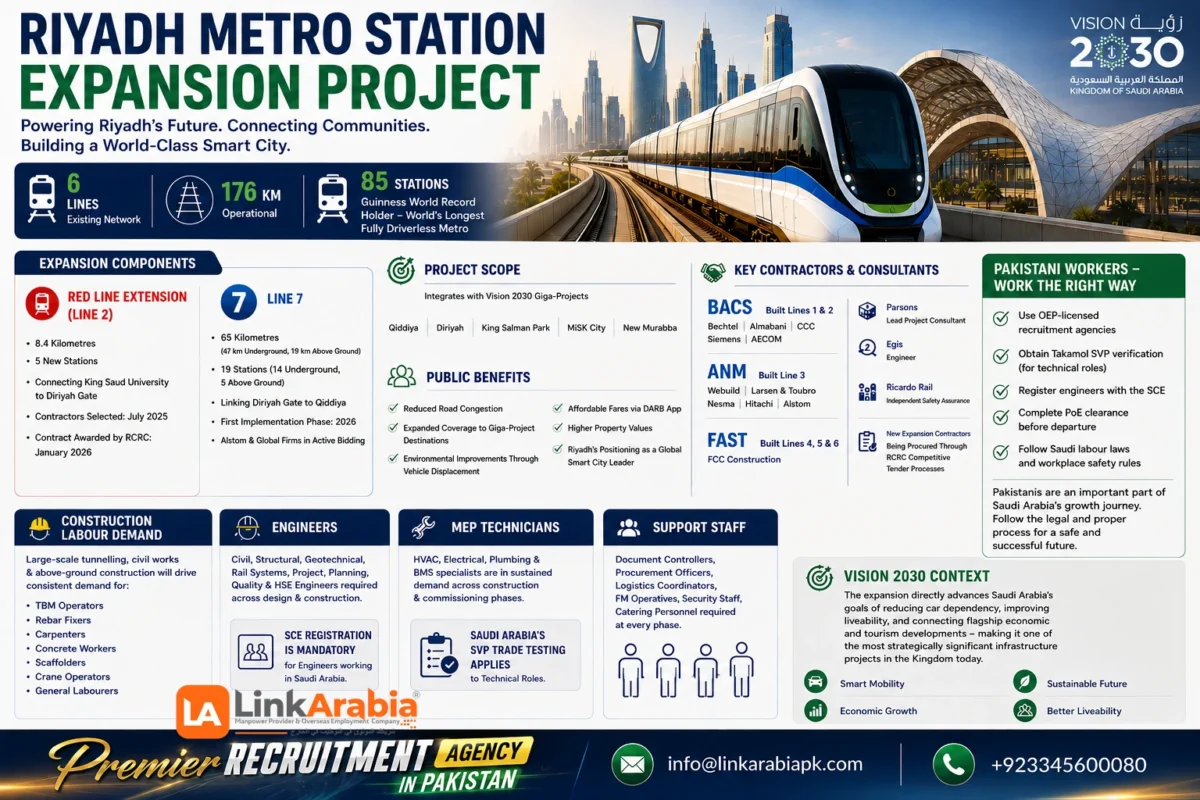
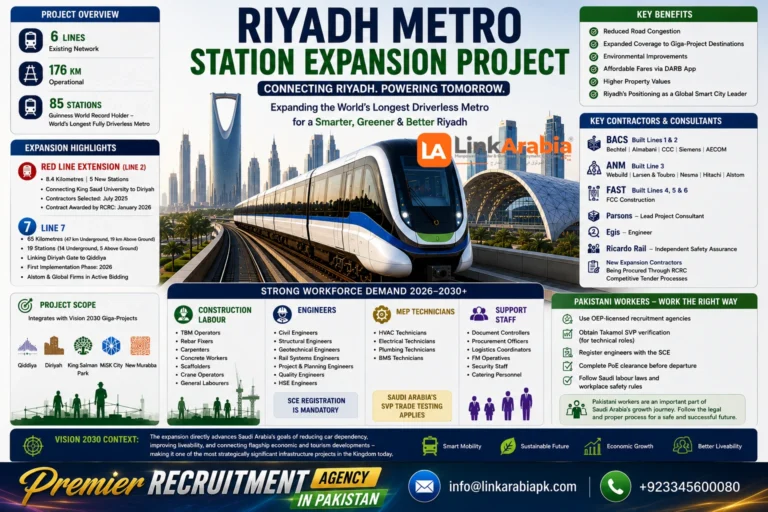
The Riyadh Metro opened to the public in phases between December 2024 and January 2025. Its six colour-coded lines span 176 kilometres and serve 85 stations, making it one of the most impressive transit systems ever built in a single phase anywhere in the world.
However, the story does not end there. The Riyadh Metro Station Expansion Project refers to a series of planned and now officially approved additions to the existing network. These include a 8.4-kilometre extension to the Red Line (Line 2), connecting King Saud University to the Diriyah Gate Development with five new stations. A brand-new Line 7 — spanning approximately 65 kilometres with 19 stations — is also under active planning and is scheduled to begin its first implementation phase in 2026.
The project falls under the umbrella of the King Abdulaziz Project for Riyadh Public Transport, led by the Royal Commission for Riyadh City (RCRC). It is one of the flagship initiatives supporting Saudi Vision 2030.
Together, these expansions are set to deepen the metro’s reach into districts currently underserved by public transport and connect major giga-projects — including Qiddiya Entertainment City, Diriyah Gate, King Salman Park, and MiSK City — directly to the metro grid.
Key Contractors Behind the Riyadh Metro Expansion
The original Riyadh Metro network was delivered by three major international consortia, each responsible for different lines. Understanding these contractors gives important context for who is likely to be involved in the ongoing expansion.
BACS Consortium — Lines 1 and 2
The BACS consortium — led by Bechtel and also comprising Almabani General Contractors, Consolidated Contractors Company (CCC), Siemens, and AECOM — was responsible for designing and constructing Lines 1 and 2. This $9.4 billion contract covered 40 stations, three depots, four park-and-ride facilities, and full train, signalling, and electrification integration.
ANM Consortium — Line 3
The ANM consortium, led by Webuild (formerly Salini-Impregilo) and including Larsen & Toubro, Nesma & Partners, Hitachi, and Alstom, delivered the $5.2 billion Line 3 contract. This included 22 stations and 11 park-and-ride facilities.
FAST Consortium — Lines 4, 5, and 6
The FAST consortium, led by FCC Construction, designed and built Lines 4, 5, and 6. Siemens Mobility supplied 67 Inspiro-type metro vehicles for these lines in two- and four-car configurations.
Project Management and Consultancy
Parsons Corporation served as the lead consultant through the Riyadh Metro Transit Consultants (RMTC) consortium, overseeing integration across all lines. Egis played the role of the ‘Engineer’ for Lines 1, 2, and 3. Ricardo Rail provided independent safety assessment (ISA) services.
Expansion-Specific Contractors
For the Red Line extension, the Royal Commission for Riyadh City officially awarded the design and construction contract in January 2026, with construction firms selected in July 2025. For Line 7, major global contractors — including Alstom — have reportedly submitted bids, as confirmed by the International Railway Journal in early 2026. A project management consultancy (PMC) contract for Line 7 was tendered by RCRC in February 2026.
The Riyadh Metro Station Expansion Project is therefore drawing the same calibre of international firms that delivered the original network — bringing with them significant subcontracting and manpower requirements that flow through to skilled workers at every level.
Riyadh Metro Line 7 Scope: Lines, Stations, and Infrastructure
The Riyadh Metro Station Expansion Project currently involves two primary components.
Red Line Extension (Line 2 — 8.4 km)
This extension runs from King Saud University westward to the Diriyah Gate Development. It includes five new stations, with construction contractors selected in July 2025 following the RCRC’s award announcement. The extension will open access to Diriyah, one of Saudi Arabia’s most culturally significant destinations and a central pillar of Vision 2030 tourism strategy.
Line 7 — 65 Kilometres, 19 Stations
Line 7 is the most ambitious element of the expansion. With a total route of approximately 65 kilometres — 47 kilometres underground and 19 kilometres above ground — this new line will link:
- Diriyah Gate Development (north Riyadh)
- MiSK City
- New Murabba
- King Salman Park
- King Abdullah International Gardens
- Qiddiya Entertainment City (southwest Riyadh)
Of the 19 stations, 14 will be built underground and five above ground. The Saudi Minister of Media confirmed in December 2025 that the first phase of Line 7 is targeted for implementation in 2026.
Beyond these two projects, future proposals include a Line 2 extension toward the western Diplomatic Quarter and eventual connectivity to King Khalid International Airport via Line 7. These additions will further expand the metro’s footprint significantly.
For detailed data on these expansion projects, the Railway Gazette International provides regularly updated coverage.
Riyadh Metro Public Benefits: What the Expansion Means for Residents
The benefits of the Riyadh Metro Station Expansion Project reach well beyond commuter convenience.
Reducing Traffic Congestion
Riyadh’s population of nearly 6 million is forecast to grow to 8 million by 2030. The original metro already planned for 1.2 million daily passengers, with a maximum capacity of 3.6 million. The network carried more than 162 million passengers in its first year of service alone — far exceeding early ridership projections. As the expansion connects new districts, the load on road infrastructure is expected to ease considerably.
Connecting Giga-Projects to the Public
Developments such as Qiddiya Entertainment City, Diriyah Gate, and King Salman Park are not just tourism attractions — they are economic engines. Line 7 will give ordinary Riyadh residents affordable access to these destinations without requiring private vehicles.
Environmental Gains
Each passenger shifted from a private car to metro reduces the city’s carbon footprint. LEED Silver certification was the minimum standard at iconic stations in the original build, and sustainability remains a core design principle in the expansion.
Accessibility and Affordability
The DARB app integrates metro, bus, and park-and-ride into a single fare system. Standard fares start at SAR 4 for a two-hour journey — highly accessible for residents across income levels. The expansion will extend this affordability into new parts of the city.
Economic Multiplier Effect
Metro connectivity raises property values, attracts commercial investment, and supports retail along corridors. International studies consistently show that every kilometre of metro coverage generates economic returns that far exceed construction cost over a 30-year horizon.
Construction Labour Demand in the Riyadh Metro Station Expansion Project
The Riyadh Metro Station Expansion Project requires enormous quantities of construction labour across disciplines and skill levels.
Civil Works and Tunnelling
Line 7 will place 47 kilometres of its route underground — requiring extensive tunnelling, cut-and-cover work, and underground station box construction. This generates sustained demand for:
- Tunnel boring machine (TBM) operators and assistants
- Formwork and shuttering carpenters
- Rebar fixers and steel fixers
- Concrete pourers and finishers
- Scaffolding erectors
- Waterproofing applicators
- Crane operators and heavy equipment operators
At-Grade and Elevated Works
The above-ground portions of Line 7 and the Red Line extension require:
- Pile drivers and foundation workers
- Precast concrete erectors
- Structural steel erectors
- Trackwork and ballast fixers
Unskilled and Semi-Skilled Labour in Pakistan
A project of this scale also requires large numbers of general labourers for excavation support, materials handling, site clearance, and concrete mixing — roles that are consistently filled by overseas workers from South Asia, including Pakistan.
Pakistani construction workers have a well-established track record in Saudi infrastructure projects. Their cultural adaptability, work ethic, and established presence in the Gulf construction market make them a consistent choice for contractors operating on mega-projects.
For those interested in how Pakistani workers can legally access construction roles in Saudi Arabia, this comprehensive guide on Saudi Arabia construction demand and Pakistani manpower provides useful background on the recruitment process and labour categories in demand.
Demand for Engineers in the Riyadh Metro Expansion Project
The engineers jobs Riyadh Metro expansion generates span every branch of the profession.
Civil and Structural Engineers in Pakistan
Design, supervision, and quality management of underground structures, elevated viaducts, station boxes, and retaining walls all require experienced civil and structural engineers. Both design-office roles and site-based project engineers are typically recruited in significant numbers.
Geotechnical Engineers in Pakistan
With 47 kilometres of tunnelling planned for Line 7, geotechnical specialists will be needed to manage ground investigation, soil behaviour monitoring, and tunnelling risk assessment.
Rail Systems Engineers in Pakistan
Signalling, automatic train control (ATC), SCADA systems, traction power, and communications-based train control (CBTC) all require highly specialised rail systems engineers — most of whom come with prior metro-project experience.
Project Engineers and Planners in Pakistan
Every major contract on a project of this scale requires contract engineers, planning engineers (primavera-skilled), quantity surveyors, and document controllers — disciplines that are in perennial demand on Gulf projects.
Quality and HSE Engineers in Pakistan
The original Riyadh Metro achieved more than 2,500 consecutive days lost-time injury-free by October 2024. Maintaining these standards on the expansion requires dedicated quality assurance engineers and HSE (health, safety, and environment) professionals at every tier of the supply chain.
Engineers planning to work in Saudi Arabia should be aware that registration with the Saudi Council of Engineers (SCE) is a standard requirement for work visa issuance and employment contract validation in the Kingdom.
MEP Technicians Demand in the Riyadh Metro Station Expansion Project
Demand for MEP technicians in Pakistan for Saudi Arabia’s metro expansion is substantial, covering three core disciplines.
Mechanical Systems
Metro stations require large-scale HVAC systems to manage extreme Riyadh temperatures — often exceeding 45°C. Chillers, ventilation fans, tunnel ventilation systems, and platform screen doors all require skilled mechanical technicians for installation, commissioning, and ongoing maintenance.
Electrical Systems
High-voltage switchgear, traction power substations, station lighting, emergency power systems, uninterruptible power supplies (UPS), and fire alarm systems all demand qualified electrical technicians. On a 65-kilometre metro line, the scale of these installations is significant.
Plumbing and Public Health
Station wet services — drainage, potable water, firefighting systems, and sewage — are complex in underground environments. Plumbing and public health technicians are required during both construction and commissioning phases.
BMS and Control Systems
Building management systems (BMS) integration across 19 new stations requires technicians experienced in SCADA, DDC controllers, and integrated facility management platforms.
Pakistani MEP technicians are increasingly sought after in Gulf infrastructure projects. For a detailed career guide on how to position yourself for these roles, the article on Pakistani MEP Technicians securing Gulf jobs covers skill verification, Saudi Arabia’s Skills Verification Program (SVP), DAE qualifications, and trade test preparation.
How to Pursue Riyadh Metro Expansion Opportunities from Pakistan
For Pakistani professionals looking to position themselves for roles generated by the Riyadh Metro Station Expansion Project, the following process applies.
Work Through Licensed Channels
All Saudi work visas for Pakistani nationals must be processed through Overseas Employment Promoters (OEPs) licensed by the Government of Pakistan. There is no legal alternative to this channel, regardless of how a candidate makes initial contact with an employer.
The Ministry of Overseas Pakistanis and Human Resources Development (MOPHRD) oversees the regulation of overseas employment from Pakistan. All workers should verify that their recruitment agency holds a valid OEP licence before proceeding.
Skill Verification
Saudi Arabia’s Skills Verification Program (SVP), administered through Takamol, is increasingly mandatory for technical and trade roles. Engineers should also ensure their credentials are assessed and registered with the Saudi Council of Engineers (SCE) prior to departure.
Protector of Emigrants Clearance
Before boarding any flight for work in Saudi Arabia, Pakistani nationals are legally required to obtain clearance from the Protector of Emigrants (PoE). This step protects workers under Pakistani labour migration laws and is non-negotiable.
For a step-by-step guide to the entire process — from skill verification to visa types to PoE clearance — the comprehensive guide on how to get a job in Saudi Arabia from Pakistan covers all the current legal and procedural requirements.
Additionally, for those unfamiliar with finding legitimate jobs in the Kingdom, the article on finding Jobs in Saudi Arabia: a guide for job seekers is a useful starting reference.
Conclusion
The Riyadh Metro Station Expansion Project represents a generational opportunity — for the people of Riyadh who will benefit from improved connectivity, and for the professionals and workers from around the world who may contribute to building it.
With the Red Line extension already under contract and Line 7 entering its initial implementation phase in 2026, the demand for construction labour, engineers, MEP technicians, and support staff is set to remain elevated over the coming years. The contractors are experienced, the regulatory framework is established, and the Kingdom’s commitment to this expansion is backed by Vision 2030 at the highest levels of government.
Those who prepare well — acquiring relevant qualifications, understanding the legal processes, and working through proper channels — are positioned to benefit from one of the most significant infrastructure expansions in the Middle East today.
⚠️ DISCLAIMER

The information provided in this article is intended for general informational purposes only. It does not constitute professional legal, financial, or career advice. While every effort has been made to ensure the accuracy of the information presented, the employment landscape, government regulations, and overseas labour market conditions are subject to change.

Readers are strongly encouraged to conduct their own independent research, consult with qualified professionals, and verify the credentials and licensing of any recruitment agency before engaging their services.

Always check with relevant government authorities, including the Ministry of Overseas Pakistanis and Human Resources Development (MOPHRD), for the most current regulations and approved agency listings.

linkarabiapk.com does not endorse, represent, or take responsibility for any specific recruitment agency or third-party service mentioned or implied in this content.