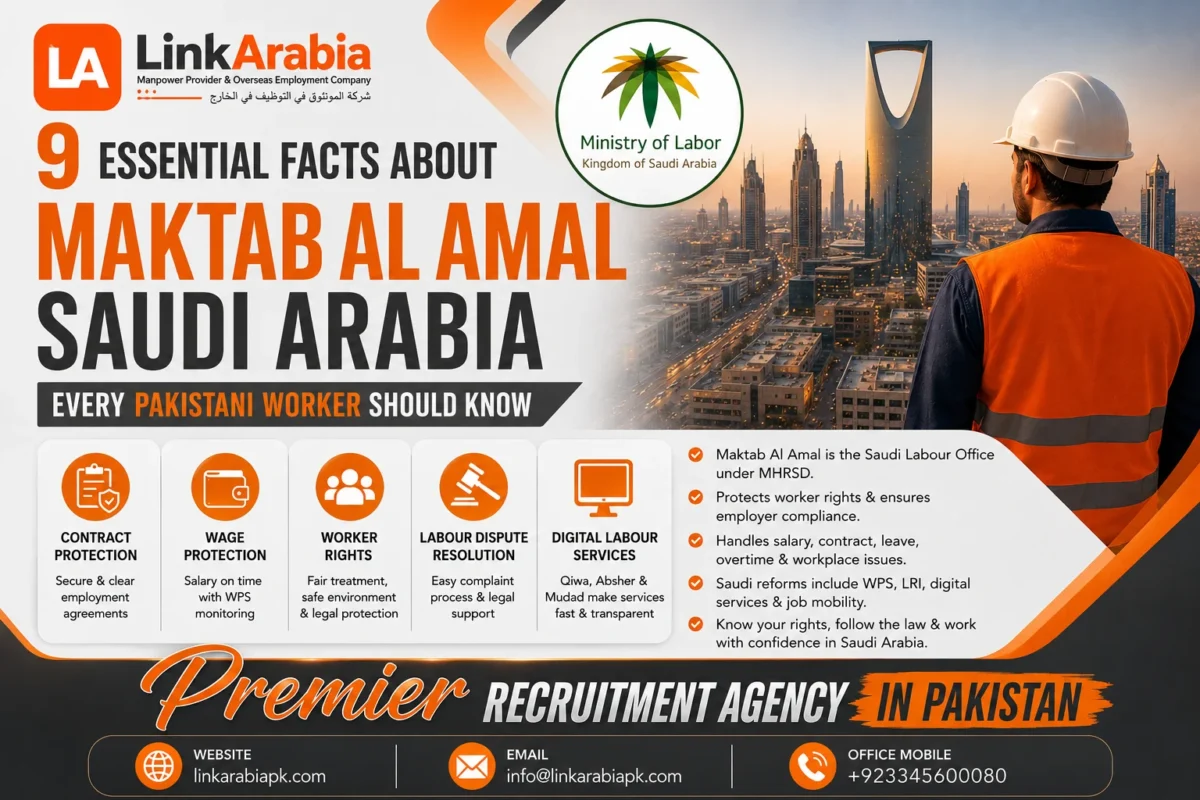
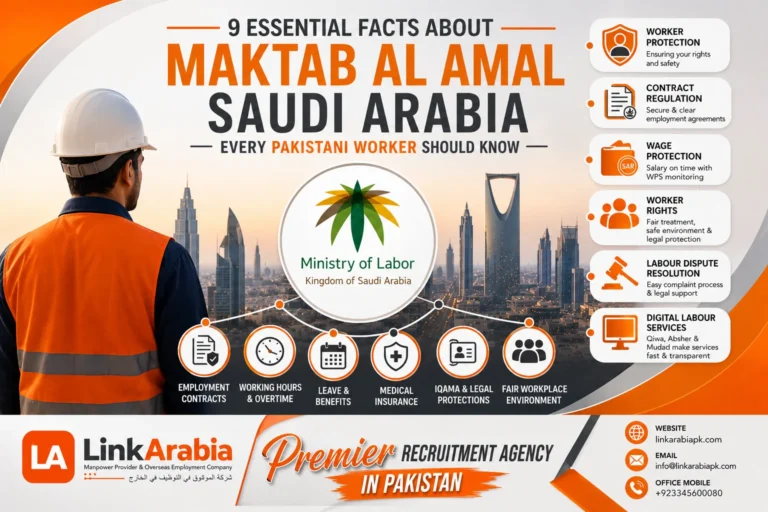
9 Essential Facts About Maktab Al Amal Saudi Arabia Every Pakistani Worker Should Know
Maktab Al Amal Saudi Arabia is one of the most important institutions responsible for regulating labour matters and protecting employee rights in the Kingdom of Saudi Arabia. Thousands of Pakistani workers travel to Saudi Arabia every year for employment opportunities in construction, engineering, oil and gas, hospitality, healthcare, transportation, maintenance, retail, and industrial sectors. Understanding how the Saudi labour system operates is extremely important for expatriate workers before signing an employment contract or travelling abroad.
Saudi Arabia has introduced significant labour reforms during the last few years to improve transparency, digital governance, worker mobility, salary protection, and dispute resolution. These reforms have directly affected expatriate manpower, including Pakistani workers. Maktab Al Amal Saudi Arabia now plays a stronger role in regulating employment relationships between employers and foreign workers.
Many Pakistani workers hear the term “Maktab Al Amal” after arriving in Saudi Arabia, but not everyone fully understands its responsibilities, legal authority, or the services it provides. Knowing these details can help workers better understand their rights, responsibilities, and legal protections while working in Saudi Arabia.
This article explains in detail what Maktab Al Amal Saudi Arabia is, how it works, how it benefits Pakistani workers, major labour reforms introduced by Saudi authorities, and the most important Saudi labour law provisions every employee should know.
For more guidance related to overseas employment and Saudi Arabia labour procedures, workers may also read resources available on LinkArabia.
What is Maktab Al Amal Saudi Arabia?
Maktab Al Amal Saudi Arabia refers to the Saudi Labour Office operating under the supervision of the Saudi Ministry of Human Resources and Social Development (MHRSD). It is responsible for regulating labour relations between employers and employees across the Kingdom.
The labour office handles matters related to:
- Employment contracts
- Salary disputes
- Labour complaints in Saudi Arabia
- Employee rights
- Work permits
- Employer compliance
- Working conditions
- Labour inspections
- End of service settlements
- Labour law implementation
In simple words, Maktab Al Amal Saudi Arabia acts as a regulatory authority ensuring that employers and workers comply with Saudi labour laws.
The Saudi labour office also assists expatriate workers in filing complaints against employers in cases involving unpaid salaries, contract violations, excessive working hours, illegal termination, denial of leave, or poor working conditions.
Saudi Arabia has modernized many labour office services through digital platforms, making it easier for workers to access labour-related services online.
Official Saudi labour resources can be accessed through Saudi Ministry of Human Resources and Social Development.
How Does Maktab Al Amal Saudi Arabia Work?
Maktab Al Amal Saudi Arabia works as an administrative and regulatory authority that supervises employment matters in Saudi Arabia.
The process generally involves the following functions:
1. Registration of Employment Contracts
Employment contracts are registered through official labour systems. These contracts include:
- Salary
- Job title
- Working hours
- Leave entitlements
- Accommodation provisions
- Contract duration
- End of service benefits
The labour office ensures contracts comply with Saudi labour law.
2. Monitoring Saudi Employer Compliance
The labour office conducts inspections and monitoring activities to ensure employers comply with labour regulations.
This includes checking:
- Salary payments
- Working conditions
- Health and safety standards
- Accommodation standards
- Work permit compliance
3. Handling Labour Complaints in Saudi Arabia
Employees can file complaints regarding:
- Salary delays
- Contract violations
- Abuse or mistreatment
- Illegal termination
- Leave denial
- Overtime disputes
The labour office attempts reconciliation between both parties before escalating matters to labour courts.
4. Maktab Al Amal Apps Digital Labour Services
Saudi Arabia has digitized many labour services through online systems.
Workers can now access:
- Contract verification
- Complaint filing
- Employment transfer requests
- Salary records
- Work permit information
through platforms such as:
- Qiwa
- Absher
- Mudad
- MHRSD portals
Official labour platforms include:
Why Maktab Al Amal Saudi Arabia is Important for Pakistani Workers
Pakistani manpower forms a major part of Saudi Arabia’s expatriate workforce. Many workers are employed in physically demanding sectors where labour protections become highly important.
Maktab Al Amal Saudi Arabia benefits Pakistani workers in several ways.
Protection Against Salary Delays
The Saudi Wage Protection System monitors salary payments electronically. Employers must pay salaries through approved banking systems.
This helps reduce:
- Delayed wages
- Partial salary payments
- Cash payment manipulation
Saudi authorities introduced strict compliance measures under the Wage Protection System (WPS).
Protection of Employment Contracts
The labour office ensures employment contracts match approved labour standards.
Workers should carefully verify:
- Salary terms
- Overtime conditions
- Accommodation clauses
- Food allowances
- Leave entitlements
before signing contracts.
Maktab Al Amal Complaint Resolution Support
Workers facing labour disputes can approach Maktab Al Amal Saudi Arabia for legal complaint registration.
This process helps employees seek resolution regarding:
- Unpaid salaries
- Contract breaches
- Workplace abuse
- Unlawful dismissal
Improved Worker Mobility
Saudi Arabia introduced labour reforms allowing expatriates more job mobility under specific conditions. The Saudi Labour Reform Initiative reduced some traditional restrictions previously associated with employment transfers.
New Labour Reforms Introduced by Maktab Al Amal Saudi Arabia
Saudi Arabia has introduced several important labour reforms in recent years aimed at improving expatriate worker welfare.
1. Wage Protection System (WPS)
The Wage Protection System is one of the most important reforms.
It electronically monitors salary payments to workers through banking channels.
Benefits include:
- Better salary transparency
- Reduced payment disputes
- Digital salary records
- Improved compliance monitoring
2. Labour Reform Initiative (LRI)
The Labour Reform Initiative introduced major reforms related to expatriate workers.
Some important features include:
- Job mobility under legal conditions
- Exit and re-entry flexibility
- Reduced dependency on employer approvals in certain cases
- Digital employment transfers
This reform significantly changed the employment environment for foreign workers.
3. Maktab Al Amal Complaint Systems Digital
Workers can now submit complaints electronically.
This has improved:
- Accessibility
- Transparency
- Faster communication
- Record management
Digital systems help workers track complaint progress online.
4. Employment Contract Documentation
Saudi Arabia now emphasizes proper digital employment contract registration.
This helps reduce:
- Fake contracts
- Contract substitution
- Unauthorized employment changes
5. Insurance Protection for Workers
Saudi authorities introduced insurance-related protections for expatriate workers in certain situations.
These measures aim to support workers during employment disputes or employer-related complications.
6. Huroob Status Correction Initiatives
Saudi Arabia periodically introduces legal status correction initiatives.
Recent policies have provided grace periods in some situations allowing workers to regularize legal status.
Important Saudi Labour Laws Every Pakistani Worker Should Know
Understanding Saudi labour law is extremely important for expatriate employees.
Below are some major labour law provisions every Pakistani worker should understand.
Employment Contract Rules in Saudi Arabia
Employment contracts are legally binding documents.
Workers should never rely solely on verbal promises.
Important contract points include:
- Salary amount
- Job title
- Contract duration
- Accommodation terms
- Food allowance
- Overtime policy
- Medical insurance
- Annual leave
Workers should always keep copies of:
- Employment contracts
- Passport
- Iqama
- Salary slips
- Work permit documents
Working Hours in Saudi Arabia
Standard working hours generally include:
- 8 hours per day
- 48 hours per week
Employees working beyond standard hours may qualify for overtime compensation as per the company policy.
Overtime Rules in Saudi Arabia
Overtime payments are regulated under Saudi labour law.
Employers are generally expected to compensate overtime work according to approved labour regulations.
Workers should maintain proper records of:
- Attendance
- Duty hours
- Shift schedules
Salary Payment Rules in Saudi Arabia
Saudi Arabia requires salary payments through authorized banking channels.
Workers should:
- Open bank accounts
- Monitor salary transfers
- Keep transaction records
The Wage Protection System helps authorities monitor compliance.
Annual Leave Entitlements in Saudi Arabia
Employees are generally entitled to annual leave after completing required service periods.
Annual leave policies may vary depending on:
- Employment contract
- Company policy
- Length of service
Workers should verify leave entitlements within their contracts.
Medical Insurance Requirements in Saudi Arabia
Employers are generally responsible for providing medical insurance coverage to employees.
Workers should understand:
- Insurance validity
- Covered hospitals
- Medical procedures
- Emergency services
End of Service Benefits in Saudi Arabia
Saudi labour law includes provisions regarding end of service benefits.
These benefits may depend upon:
- Length of employment
- Nature of resignation
- Contract type
Workers should carefully review settlement calculations before signing final clearances.
Exit Re-Entry and Final Exit Rules
Saudi Arabia regulates travel procedures for expatriate workers.
Workers should understand:
- Exit re-entry validity
- Final exit procedures
- Passport validity requirements
- Pending legal cases
Official digital systems now handle many visa-related processes electronically.
Labour Complaint Procedure in Saudi Arabia
If a worker faces labour issues, the following steps are generally followed:
Step 1: Attempt Internal Resolution
Employees should first attempt communication with employers or HR departments.
Step 2: File Complaint with Labour Office
If unresolved, workers may approach Maktab Al Amal Saudi Arabia.
Complaints may involve:
- Salary disputes
- Contract violations
- Abuse complaints
- Termination disputes
Step 3: Mediation Process
The labour office often attempts reconciliation.
Step 4: Labour Court Referral
If settlement fails, matters may proceed to labour courts.
Workers should maintain documentation supporting their claims.
Rights and Responsibilities of Pakistani Workers in Saudi Arabia
Understanding rights is important, but workers must also understand responsibilities.
Rights
Workers generally have rights regarding:
- Salary payment
- Safe working conditions
- Medical care
- Leave entitlements
- Legal complaint access
Responsibilities
Workers are also expected to:
- Follow company policies
- Respect Saudi laws
- Maintain legal documentation
- Avoid unauthorized work
- Comply with contract terms
Digital Transformation of Saudi Labour Systems
Saudi Arabia has invested heavily in digital labour governance.
Major platforms now include:
Qiwa
Qiwa manages labour-related digital services.
Services include:
- Employment contracts
- Transfers
- Labour compliance
- Company verification
Absher
Absher provides government digital services including:
- Iqama services
- Visa management
- Personal records
Mudad
Mudad supports payroll and salary compliance systems.
Digital transformation has improved transparency for both employers and employees.
Conclusion
Maktab Al Amal Saudi Arabia plays a central role in protecting labour rights, regulating employment relationships, and improving workplace standards for expatriate workers. Pakistani employees working in Saudi Arabia should understand how the labour office functions, how Saudi labour laws apply to foreign workers, and how modern labour reforms affect employment conditions.
Saudi Arabia has introduced important reforms including the Wage Protection System, Labour Reform Initiative, digital labour services, electronic contracts, and worker protection systems. These changes have significantly improved transparency and labour governance across multiple sectors.
Understanding employment contracts, salary rules, working hours, leave policies, iqama regulations, and complaint procedures can help Pakistani workers make more informed employment decisions while working in Saudi Arabia.
Workers should always remain informed through official government resources and authenticated labour platforms before making employment-related decisions.
Frequently Asked Questions (FAQs) (Maktab Al Amal)
1. What is Maktab Al Amal Saudi Arabia?
Maktab Al Amal Saudi Arabia is the Saudi Labour Office operating under the Ministry of Human Resources and Social Development responsible for labour regulation and worker protection.
2. Can Pakistani workers file complaints at Maktab Al Amal?
Yes, workers can file labour complaints regarding salary disputes, contract violations, and workplace issues.
3. What is the Wage Protection System in Saudi Arabia?
The Wage Protection System monitors salary payments electronically to improve payment transparency.
4. What is the Labour Reform Initiative in Saudi Arabia?
The Labour Reform Initiative introduced employment mobility reforms and digital labour services for expatriate workers.
5. How can workers check iqama status?
Workers can check iqama status through official digital platforms such as Absher.
6. Are employment contracts mandatory in Saudi Arabia?
Yes, employment contracts are important legal documents regulating employment relationships.
7. What should workers do before signing contracts?
Workers should carefully review salary, benefits, leave policies, accommodation, and overtime clauses.
8. Can workers change employers in Saudi Arabia?
Certain labour reforms introduced mechanisms allowing job mobility under approved legal conditions.
9. What documents should workers keep safely?
Workers should keep copies of passports, iqamas, contracts, salary slips, and insurance records.
10. Why is understanding Saudi labour law important?
Understanding labour law helps workers protect their legal rights and comply with Saudi employment regulations.
⚠️ DISCLAIMER

The information provided in this article is intended for general informational purposes only. It does not constitute professional legal, financial, or career advice. While every effort has been made to ensure the accuracy of the information presented, the employment landscape, government regulations, and overseas labour market conditions are subject to change.

Readers are strongly encouraged to conduct their own independent research, consult with qualified professionals, and verify the credentials and licensing of any recruitment agency before engaging their services.

Always check with relevant government authorities, including the Ministry of Overseas Pakistanis and Human Resources Development (MOPHRD), for the most current regulations and approved agency listings.

linkarabiapk.com does not endorse, represent, or take responsibility for any specific recruitment agency or third-party service mentioned or implied in this content.